The right Transport Fever 3 train is the least expensive complete consist that can carry the required passengers or cargo at a useful frequency on its actual route. Do not choose from locomotive speed alone. Check the coaches or wagons, supported cargo, capacity, loading speed, train length, route geometry, track equipment, station length, demand, and maintenance cost before buying.
Keep an existing train when it still clears the waiting load and runs the service reliably. Extend it when capacity is the visible constraint and the station can accept a longer consist. Replace it when a new formation solves a specific problem that the old one cannot solve economically, such as insufficient capacity, incompatible cargo wagons, inadequate pulling performance, or an unusable speed limit elsewhere in the consist.
Start With the Job the Train Must Perform
Begin with the line rather than the vehicle store. A locomotive that looks impressive in isolation can be wasteful when its coaches, wagons, stations, or route prevent the complete train from using its capabilities.
For a passenger service, inspect how many people are waiting and how much of the current capacity is actually used. A small powered passenger unit may suit a quiet connection because its displayed formation already includes passenger space. A locomotive-and-coach train offers more freedom to change capacity, but its real cost includes every vehicle in the consist. Compare complete formations instead of comparing a powered unit with a locomotive by itself.
A short route with frequent stops may gain little from a very high maximum speed. Curves, stops, traffic, and acceleration all reduce the time spent at that maximum. On a longer and clearer corridor, additional speed can become useful, but only when the coaches, track, and stations support it. Capacity or loading performance may be the more important upgrade on a busy stopping service.
For freight, identify the exact cargo before choosing a wagon. Freight vehicles are not interchangeable merely because they all display capacity. The store provides cargo-category filters, and the wagon information shows its specialization. A large wagon that cannot carry the line’s cargo has no practical capacity at all.
Also decide whether the freight problem is volume, loading, train length, or pulling performance. A newer wagon can be faster without carrying more per vehicle. A shorter wagon may allow more units to fit within the usable train length, while a specialist wagon may trade flexibility for a better loading rating. Judge the completed formation, not the model year.
Read the Train Store as a Consist Builder
The train store separates locomotives, wagons, and multiple units into categories. Use these categories to assemble and compare complete candidates. Search and sorting controls help narrow the list, while the ascending or descending toggle lets you examine either end of the selected property.
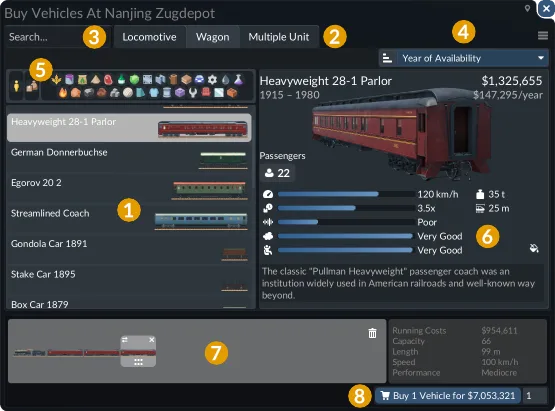
The vehicle store is where locomotive, wagon, coach, and multiple-unit specifications can be compared.
Use the store in this order:
- Select the appropriate locomotive, multiple unit, coach, or wagon category.
- For freight, activate the cargo buttons for every cargo type the proposed vehicle must carry.
- Sort by the property related to the line’s visible problem instead of defaulting to maximum speed.
- Read the selected vehicle’s cost, maintenance cost, availability, and cargo specialization.
- Inspect technical and town-related properties, including loading speed, passenger comfort, noise, and pollution where applicable.
- Add the intended coaches or wagons in the consist area and evaluate the formation as one train.
- Check that no coach or wagon imposes a lower speed than the locomotive capability you intend to buy.
- Compare the completed candidate with the train already serving the line.
A locomotive upgrade does not automatically create a faster service. If the attached vehicles have a lower speed limit, that limit remains part of the consist. Likewise, paying for more locomotive capability does not help when the route is dominated by tight curves, closely spaced stops, or other restrictions.
Maintenance cost deserves the same attention as purchase cost. A replacement with a similar purchase price can still be substantially more expensive to operate. The correct comparison is therefore not old purchase price against new purchase price. Compare the new formation’s ongoing expense with the problem it is expected to solve.
Availability matters as well. Trains and wagons unlock over time, so a vehicle discussed as a useful later option may not be purchasable in the current year. Work with what the store currently offers rather than planning around an unavailable model.
Match Every Part of the Consist
A train works as a system. The locomotive supplies the capability to move the formation, while the coaches or wagons determine what can be carried, how much can be carried, and whether another component limits speed or loading.
For passenger trains, compare these fields together:
| Check | Why it matters | Warning sign |
|---|---|---|
| Total passenger capacity | Determines how many waiting passengers the formation can move | Passengers are regularly left behind |
| Maximum speed of every component | A slower coach can limit the benefit of a faster locomotive | New locomotive is faster, but coaches are not |
| Loading speed | Affects how the consist behaves at stops | Station work is the visible delay |
| Complete train length | Determines whether the formation suits existing stations | Added coaches no longer fit the intended platform arrangement |
| Maintenance cost | Continues after the purchase is made | Capacity is mostly empty while costs rise |
| Passenger comfort, noise, and pollution | These are displayed properties that can affect the wider service decision | A technically faster option creates an unwanted trade-off |
For freight trains, replace passenger capacity and comfort with cargo compatibility, wagon capacity, loading rating, wagon length, and loaded-route performance. A general-purpose wagon can preserve flexibility, while a compatible specialist wagon may offer a different loading rating. The right choice depends on the cargo and service, not on a universal ranking.
Do not assume a newer wagon is a capacity upgrade. It may instead offer more speed, a shorter body, or a different loading rating. Those improvements can be useful, but they answer different problems. If the current train cannot exploit the extra speed and already clears the available cargo, keeping the older wagons can be the better decision.
Fit the Train to Demand and Route Shape
Use observed demand to set capacity. When the current train leaves with substantial empty space, a larger replacement needs a clear reason. When passengers or goods are routinely left behind, compare three responses: extend the formation, replace it with a better-matched formation, or add another departure.
Extending a train increases capacity without automatically improving frequency. Adding another train can improve service frequency but also adds another complete vehicle to operate. Replacing the formation may improve capacity, loading, speed, or pulling performance, but it can raise both purchase and maintenance costs. The best response is the one aimed at the measured bottleneck.
Route shape determines whether speed has value. A train on a short stopping service may spend much of the journey accelerating, braking, or waiting at stops. A faster advertised maximum does not guarantee a meaningfully faster trip. A longer route with fewer interruptions gives a fast consist more opportunity to use its capability.
Freight requires an additional loaded-performance check. A locomotive that moves an empty or short formation comfortably may behave differently after more wagons and cargo are added. Watch the train on the demanding part of its actual route before concluding that the locomotive is adequate or inadequate. Upgrade for a demonstrated load problem, not merely because another locomotive has a larger specification number.
Check the Railway Before You Upgrade
A train purchase cannot correct infrastructure that prevents the formation from using it. Before replacing a service, follow the route from depot to line and inspect the basic compatibility conditions.
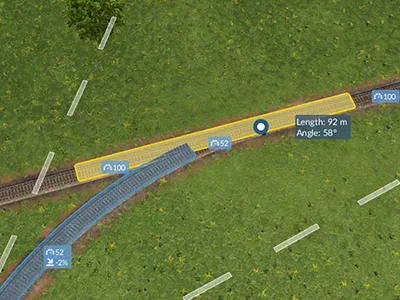
Track alignment tools show the route geometry to inspect before upgrading trains.
Tracks display speed restrictions around curves while they are being built. A route with repeated low-speed geometry cannot make full use of a high-speed train. The track tools also distinguish track options with and without catenary, and stations can mix individually upgraded or electrified track modules. If the proposed train requires equipped track, verify the entire usable path rather than assuming that one upgraded station track makes the route compatible.
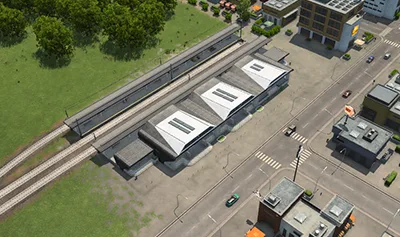
Inspect the station tracks and platforms when planning the consist.
Check the station arrangement against the complete consist. Rail stations can be expanded with 40-meter modules and can combine through and terminus tracks. That flexibility allows a station to be adapted, but the existing platform arrangement still needs to suit the train you intend to run. Count the locomotive and every coach or wagon when judging formation length.
Finally, check depot reachability. Vehicles cannot be transferred directly from one depot to another. Buy the replacement in a depot from which it can reach the intended line. If a running vehicle is sent back, it goes to the nearest reachable depot rather than necessarily returning to the depot where it was purchased.
Treat signals, line priority, and wider network congestion as prerequisites rather than train-selection features. If a train is stationary because its path is blocked, a larger or faster replacement does not address the cause.
Replace or Extend an Existing Train
The vehicle management screen lets you work with one train or a selected group. Selecting a line or depot can automatically add its vehicles to the management list, so confirm the selection before applying an action to multiple trains.
Use this replacement sequence:
- Open the existing train and record its current load, capacity, line rate, line frequency, maintenance cost, and recent balance.
- Identify one primary reason for changing it: capacity, compatibility, loading, pulling performance, speed that the route can use, or excessive operating expense for the delivered service.
- Check the intended formation in the train store, including every coach or wagon.
- Confirm the route, station, track-equipment, and depot conditions needed by the proposed train.
- Select the train in vehicle management.
- Use rearrangement when the solution is to move, remove, or add wagons or coaches. This menu can also extend trains.
- Use replacement when the complete vehicle or formation must change. The replacement interface follows the same general structure as the purchase window.
- If assigning a newly purchased vehicle to a line, choose the first stop it should approach when that option is presented.
- Return to the line and observe the changed service before repeating the purchase across the fleet.
Cloning is available for compatible depots, but the clone may be created in a depot that is not connected to the intended line. Verify its location and route access before treating cloning as a quick capacity solution.
Avoid changing an entire fleet simply because a new model unlocked. Test the decision on the service that has the clearest need. A working older train is not automatically obsolete, and replacing several consists multiplies any unnecessary maintenance-cost increase.
Diagnose the Train Before Spending
Use the vehicle details window to separate train problems from route or demand problems. It shows the current state, current speed or loading information, assigned line, line rate and frequency, current load and capacity, condition information, and a balance graph comparing running costs with income.
| Observed result | Check first | Appropriate train decision |
|---|---|---|
| Train regularly departs mostly empty | Demand, capacity, and frequency | Keep it or consider a smaller formation; do not add capacity without another reason |
| Passengers or cargo are repeatedly left behind | Current load, total capacity, station fit, and frequency | Extend, replace with more capacity, or add another departure |
| Fast locomotive produces little journey improvement | Coach or wagon speed, curves, stops, and route restrictions | Keep the locomotive or upgrade the limiting component only |
| Freight does not match the intended load | Wagon cargo specialization and active cargo filters | Replace incompatible wagons with vehicles that support the cargo |
| Longer train performs poorly when loaded | Complete weight, locomotive capability, and demanding route sections | Compare a stronger locomotive or a shorter formation |
| Newer wagon offers no extra capacity | Speed, loading rating, wagon length, and maintenance cost | Upgrade only if one of those differences solves the actual constraint |
| Train fits the job but loses money | Vehicle balance, unused capacity, maintenance cost, and delivered demand | Reduce excess capacity or reconsider the formation before buying a more expensive train |
| Proposed electric train cannot reach the service | Catenary coverage, connected depot, and usable station tracks | Prepare the route or choose a compatible train |
| Train waits despite adequate specifications | Path availability and network obstruction | Fix the railway problem; do not treat vehicle replacement as the solution |
The balance graph is especially useful after a change. Blue bars higher than red bars for a year indicate that the vehicle operated profitably during that period. Do not use one impressive trip as proof that the replacement works. Confirm that the formation carries useful loads over time and that its additional cost is justified by the service it delivers.
Use a Keep, Extend, or Replace Decision
Keep the current train when it carries the required load, fits its stations, uses compatible vehicles, and maintains a useful service without an identified capability problem. Age by itself is not a reason to replace it.
Extend the train when capacity is the main constraint, compatible coaches or wagons are available, the locomotive can manage the resulting formation, and the stations can accept the added length. Recheck performance after the added vehicles begin carrying real loads.
Replace the train when the complete new formation directly addresses a supported problem. Good reasons include incompatible cargo vehicles, capacity that cannot be added sensibly to the current formation, insufficient performance under the required load, or a route that can genuinely use the new train’s speed. Compare the resulting maintenance cost before confirming the purchase.
If several options appear suitable, choose the affordable candidate that meets the current requirement and preserve room to expand later. Buying unused capability creates an immediate and continuing expense, while a formation that can no longer meet demand also has a cost in unserved passengers or cargo.
Verify the New Train in Service
After the train enters service, inspect the result rather than assuming the purchase solved the problem:
- Confirm that it reached the intended line from its depot.
- Confirm that every freight wagon accepts the required cargo.
- Watch current load against total capacity on several departures.
- Check whether waiting passengers or cargo are still being left behind.
- Observe the train on curves, between closely spaced stops, and on the route’s demanding loaded section.
- Verify that station length and track equipment suit the complete formation.
- Compare the resulting line rate and frequency with the values recorded before the change.
- Review the vehicle balance after it has produced meaningful running-cost and income data.
- Check whether the original bottleneck disappeared or merely moved elsewhere.
A successful upgrade has a visible result: the required load moves, the formation is compatible with the line, and the added capability is used often enough to justify its cost. If those conditions are not met, reverse the decision while it is still limited to one service rather than copying the same mismatch across the railway.