
Earn three stars in Transport Fever 3 Mission 6, Island Expansion, by successfully completing 12 subsidy contracts. Five successful contracts earn one star and eight earn two. The Trans-Philippine Railroad is a separate medal objective. Plan each contract around its own deadline; the star conditions are successful-contract counts rather than a single global finishing year.
The mission starts in Manila in 1999 and moves through economic development, social services, and tourism across the Philippines. Build useful connections before accepting obligations you cannot yet deliver. A failed contract can cost money, but one failed contract does not automatically prevent a three-star result if you still complete the required number successfully.
Track contracts and the railway medal separately
| Result | Requirement | What to follow |
|---|---|---|
| One star | 5 successful subsidy contracts | Completed successful contracts |
| Two stars | 8 successful subsidy contracts | The same success counter |
| Three stars | 12 successful subsidy contracts | Individual deadlines and remaining achievable contracts |
| Medal | Construct the Trans-Philippine Railroad | The separate railway objective and its marked locations |
Do not count a new line, a cargo pickup, or an accepted offer as a successful contract. The task needs the stated transportation result. Check the contract's completion state after making the delivery or carrying the required visitors or workers.
The railway can support the wider mission economy, but its medal is not a substitute for the subsidy counter. Likewise, completing 12 contracts does not demonstrate that the entire railway objective was fulfilled. Keep both goals visible as the mission opens new work.
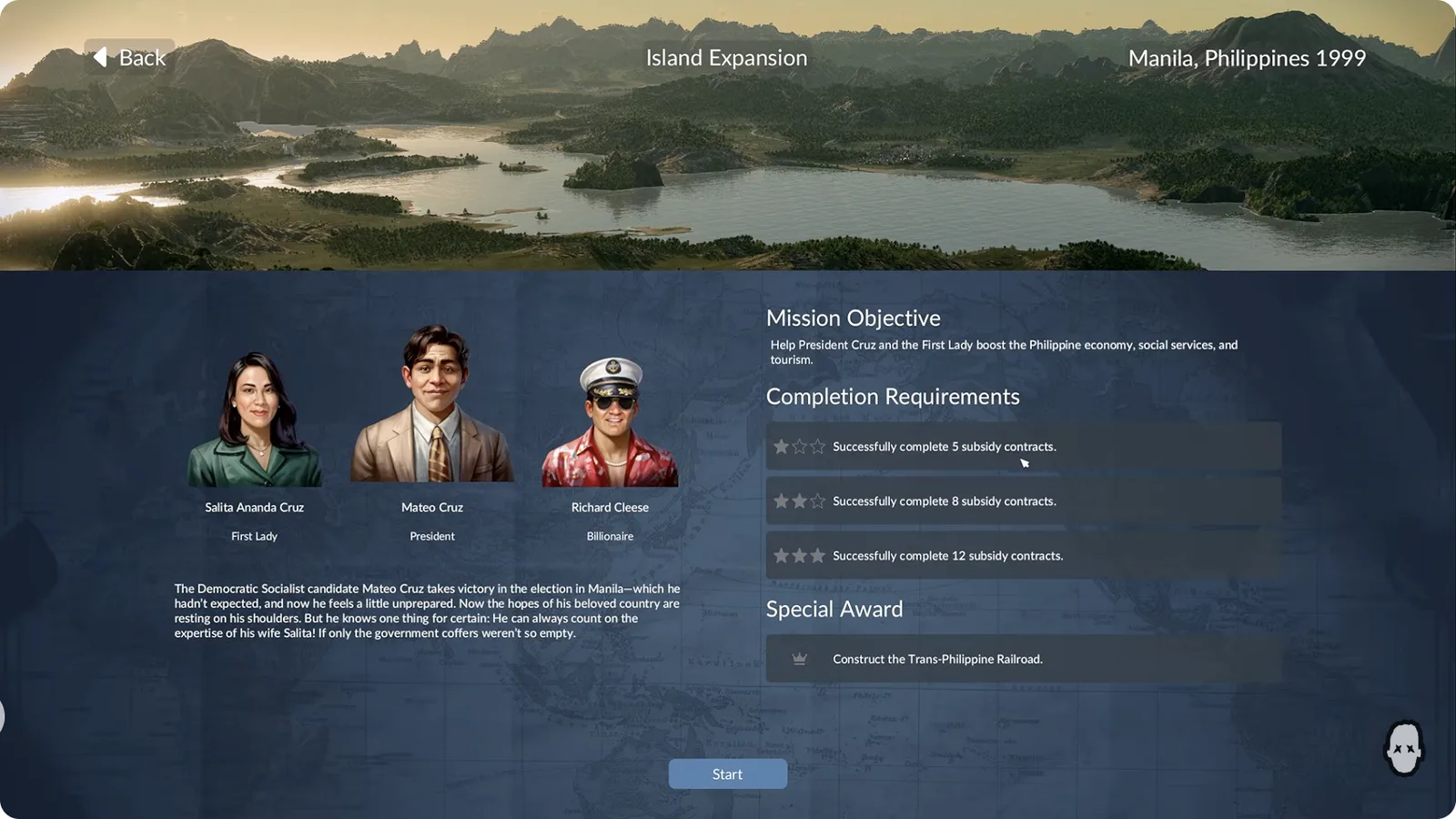
The subsidy counter determines stars; building the Trans-Philippine Railroad is a separate reward.
Prepare each connection before accepting the offer
Early mission dialogue warns that a contract should be accepted only when it can be completed within its remaining deadline. Missing an obligation can incur a substantial penalty. Use the offer's requirements to inspect the route before you make that commitment.
For a cargo task, locate the specified producer, destination, and compatible transport. For a worker or visitor task, establish the passenger origin and access to the actual workplace or attraction. An apparently nearby stop is not a complete connection until the required journey can be made.
Some construction can be prepared before accepting the associated contract. Use that opportunity to reduce the period spent building while the accepted obligation is active. This does not mean an offer's remaining time can be ignored: read the actual task and its current deadline when you are ready to proceed.
Avoid starting several unfinished obligations simultaneously merely because they appear in the same phase. A completed connection provides income and a confirmed success, while several partly built routes consume funds without yet improving the success counter. Choose the next contract according to its specific access and the network already available.
Establish the first economic services
The early economy tasks include Rubber for the Davao tire factory, Coconuts for Davao, furniture-factory inputs, worker transport, and Fuel for Manila. These are mission-specific demands, not a list of products every Free Game town requires.
| Early service | Connection to establish | Important distinction |
|---|---|---|
| Davao tire production | Rubber source to the tire factory | Deliver the factory input rather than finished Tires |
| Davao coconut task | Specified coconut source to the town receiver | Follow the mission's cargo and quantity |
| Furniture production | Planks and Glass to the furniture factory | The factory needs the required materials, not unrelated timber cargo |
| Worker contract | Residential access to the specified workplace | Cargo vehicles do not carry the workers |
| Manila fuel supply | Oil production and refining, then Fuel to Manila | Crude Oil and Fuel are different products |
For furniture, the demonstrated chain brings Logs to a Saw Mill and then moves Planks to the Furniture Factory, with Glass supplied as the other material. Check both inputs. One material waiting at the factory does not establish that its whole production requirement has been supplied.
Use the quantity displayed by the active contract. Do not combine two materials into an assumed shared total unless the task explicitly states that condition. A factory supply task and a town delivery task can have different counters even when they belong to the same economic phase.
For workers, check actual passenger movement to the named workplace rather than the total ridership of a nearby bus line. The early worker task asks for transported workers; a line carrying residents around town without reaching the workplace may not advance it.
Complete the Manila fuel connection
The Manila fuel task involves an oil shipping leg, production at the receiving facility, and a final Fuel delivery to the city. Establish the final receiver as part of the same plan so that processing output does not accumulate with no useful town connection.
Buy vehicles for their actual cargo capability. The ship must carry the incoming oil cargo, while the last road leg needs Fuel compatibility. A tanker moving Crude Oil correctly is not proof that a truck selected for a different product can serve the final delivery.
When money is limited, start with a receiving arrangement that completes the requested service rather than building the largest terminal everywhere. Expand after the first working transfer. The mission's low initial resources make a complete smaller route more useful than an impressive but unfinished port-and-road system.
Watch a shipping cycle and an onward delivery. Verify where the cargo is produced, where it is unloaded, and whether the final town counter rises. If the receiving point has material but the final vehicles leave empty, inspect the transfer and selected cargo before adding another ship.
Build the Trans-Philippine Railroad in stages
The railway plan calls for a connection from the north, through the eastern islands, toward Davao in the south, without requiring passengers to change trains along that journey. Accept the railway plan and use the task's marked towns and route requirements to guide construction.
Do not substitute an invented complete city sequence for those markers. Follow the objective in your current mission, place the required passenger stations, and connect them into the continuous service the railway task requests.
A practical sequence is to operate a completed section before the entire corridor is finished:
- Locate the next marked town and its required passenger connection.
- Build the station and the connecting track section.
- Check that the operating train can reach the station and continue or return as intended.
- Open service over the usable section to begin earning income.
- Extend the track and line toward the next marked destination.
- Verify the full requested journey when the corridor is connected.
This staged approach is supported by the railway task's advice to earn income between stations while extending the route. It is not a guarantee that one train remains sufficient throughout the mission. Later visitor tasks can place additional demands on the corridor.
Connect residential areas to the railway stations with useful local passenger services. The railway's length alone does not establish that residents can board it. A local feeder should reach both the homes and the rail station, with an operating vehicle and a valid path.
Use the railway completion dialogue or task status as the medal confirmation. A track line reaching Davao on the map is an intermediate construction result; the task's accepted passenger connection is the result you need to verify.
Rebuild the school after the storm
A later tropical storm destroys the school, creating a rebuilding task. Deliver 50 Logs to the specified construction site. Use the task marker to locate the receiver and check the delivered quantity, not merely the amount waiting at the logging source.
The next school task concerns visitors. This is a passenger-access problem after the construction supply problem, so it requires a separate check. Completing the Logs delivery does not prove that the rebuilt school is receiving people.
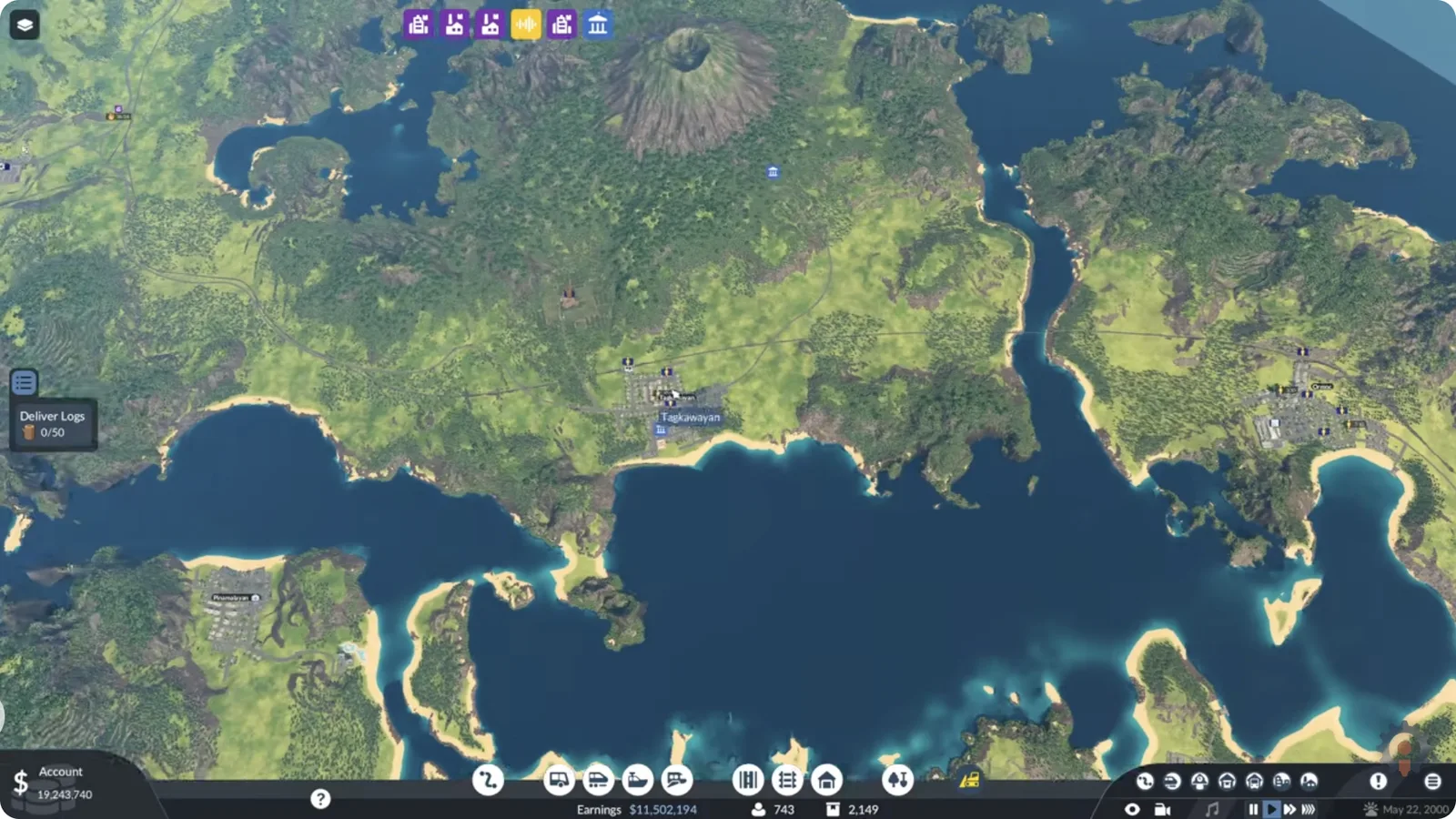
Deliver 50 Logs for the school rebuilding task before checking the later visitor objective.
The demonstrated small local bus loop initially attracts too few school visitors. The useful repair is to connect the school with the wider passenger network, including railway access and feeders, then inspect actual arrivals. More buses repeating an unproductive local loop do not necessarily bring new visitors from farther away.
If the railway becomes the limiting part of that passenger journey, inspect its operation. Additional trains and suitable passing opportunities can help a busy single-track service, but they need a valid signaled layout. Do not add another train to an unresolved track conflict and expect the visitor task to repair itself.
A school contract failure is costly but should be evaluated against the remaining success target rather than treated as an automatic loss of all stars. A completed run can still earn three stars and the railway bonus after a school contract fails, provided enough other contracts succeed.
Connect the social-service deliveries
The social-service stage also includes food and medicine deliveries. These tasks use their own receivers and requirements. Keep the mission cargo names visible, especially for special goods that are absent from the ordinary Free Game cargo directory.
Follow each task marker through the whole connection. For a multi-leg service, verify that the first delivery reaches working storage or the intended receiver and that the next vehicle can load the same task cargo. A busy first leg does not establish that the service reached its final destination.
Where two medicine services are offered, treat them as separate connections until the task panel confirms otherwise. Do not assume that completing one location's delivery advances another location's counter. Read the destination and deadline for each obligation before sharing vehicles or capacity.
Keep the successful services running while preparing the next phase. Their income and passenger connections can support later work, but continue to inspect the task-specific result when you accept a new contract that uses an existing route.
Handle tourism and the stranded yacht
The tourism phase includes visitors to a nature reserve and task-specified intercity passenger connections. Use the established railway and feeders where they provide the required journeys, then check the attraction's actual visitor progress. The presence of tourists somewhere on the line is not evidence that they reached the reserve.
A stranded yacht later creates a cargo-removal task near a coral reef. Establish the designated safe receiving or storage location and use a ship compatible with the task's cargo. Follow the cargo label and receiver shown by the objective; do not confuse story dialogue about diesel with an assumed universal cargo setting.
Check both pickup and safe delivery. A vessel visiting the stranded yacht without moving the cargo to the required destination has not completed the cleanup. Make the receiving arrangement part of the plan before buying additional vessels.
Later tourism work includes additional food deliveries and visitors to a diving school. These are new obligations with their own quantities and destinations. Reuse the network where it genuinely serves them, but confirm each counter rather than assuming the tourism phase is complete after its first successful attraction service.
Verify the final star and medal results
Return to the mission's result counters after the final successful deliveries. Confirm at least 12 successful subsidy contracts for three stars and the separate Trans-Philippine Railroad result for the medal. Track those accepted results rather than estimating success from the number of vehicles or lines constructed.
For contract acceptance and deadline mechanics, use Subsidies. For passenger access to industry tasks, use Industry Workers. For the next campaign mission, continue with Mission 7.