

Complete Transport Fever 3 Mission 7, Big City Problems, by convincing all voters in Adelaide. Two stars require doing this within four years, and three stars within two years. The separate Cheers reward involves the cultural festival and a one-time delivery of 50 drinks from the McLaren Valley brewery to the Botanic Garden.
The mission begins in 2015 with several district problems already active. Work on the districts' measured conditions while keeping passenger and cargo services running. Support can rise when enough conditions are satisfied and fall again when services deteriorate; making an indicator green once is not the same as reaching and holding the final 100% result.
Read the district conditions before rebuilding
Select the mission's district objectives and inspect their required values. The demonstrated voter system needs at least three conditions satisfied for support to increase. Read the numeric threshold and current value alongside the color rather than assuming every green-looking display has met the task condition.
| Area | Main problem to investigate | First operational check |
|---|---|---|
| Southwest | Public transport and noise | Residential passenger journeys and nearby noise exposure |
| Southeast | Traffic congestion | The connected road movements and the front of recurring queues |
| Northwest | Industry support and air quality | Steel supply, its inputs, and the pollution affecting the area |
| Northeast | Public-transport waiting and comfort | Residential coverage, station access, vehicles, and effective service |
| Center | Cargo delivery time | Age of stock, freight handling, waiting, and the last delivery leg |
These areas are not interchangeable. A bus project in the northeast does not demonstrate that central cargo is timely, and a new steel train does not establish that southwestern residents experience less noise. Keep each intervention tied to the district condition it is intended to improve.
For a three-star attempt, identify usable existing infrastructure before constructing a new network everywhere. The deadline concerns the whole voter result, so a beautiful rebuilt district is insufficient if the other districts remain below their conditions when the two-year window ends.
Relieve the southeast road constraint
Start with the road traffic actually causing the southeast problem. Trace queues to the point where vehicles repeatedly stop and inspect the onward connections. The demonstrated repair adds cross-district routes and later adjusts one-way directions, but its particular elevated-road alignment is one workable design rather than a compulsory blueprint.
Choose a connection that gives the required movements a usable alternative. After building or changing the road, inspect the resulting paths at both ends. A new road that leads into another constrained junction can move the queue without satisfying the district's traffic condition.
When changing one-way direction, check which movements must still reach the district. A directional shortcut can help one flow while cutting off a required return or service path. Verify the actual line routes and traffic movement after the edit.
Use the district's value as well as the Traffic layer to judge the repair. The layer helps locate the problem, while the mission condition determines whether the area now qualifies. If the condition remains short of its threshold, inspect the remaining bottleneck rather than repeating the same road expansion everywhere.
Rebuild northeast passenger coverage
The northeast problem involves passenger waiting and comfort. The demonstrated solution uses clockwise and counterclockwise tram services covering residential areas and linking them to the railway station. The useful principle is a complete journey between homes, useful destinations, and the wider passenger network.
Check the stops before duplicating vehicles. Confirm that the service reaches the residential origins and that the railway transfer can actually be used. A line passing through the district with no useful residential access does not provide the required passenger service merely because its route is long.
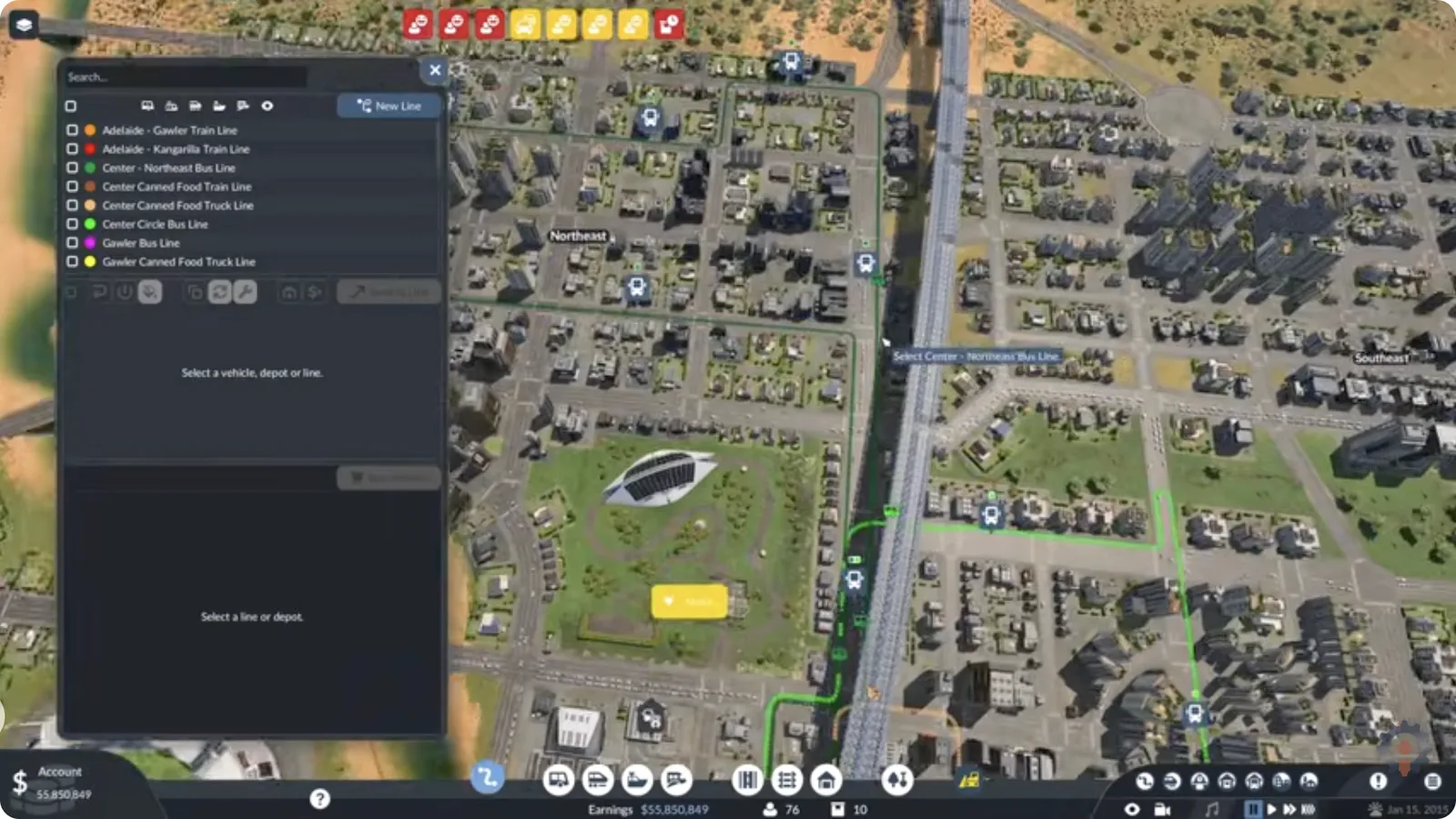
Inspect the existing passenger route and residential coverage before rebuilding the northeast service.
Build and inspect the tram service in this order:
- Identify residential areas that lack a useful passenger connection.
- Choose stops serving those areas and the railway station.
- Establish a continuous tram path, including the station approaches.
- Configure the line's stop order for the intended direction.
- Assign compatible vehicles rather than leaving the line empty.
- Inspect waiting passengers, actual movement, and the district's condition values.
Opposite-direction services can provide complementary journeys, but their usefulness depends on coverage and operation. Do not treat two colored line paths as evidence that both are carrying passengers effectively. Check where vehicles wait and whether the intended transfer remains accessible.
The area can lose support later if passengers become dissatisfied again. Revisit it after expanding other parts of the network. Initial improvement is a starting point for maintaining the service, not permission to ignore the northeast for the rest of the mission.
Fix missing electric tracks at station modules
A demonstrated rail service encounters Missing electric tracks even after the main railway has been electrified. The remaining missing component is the station track. Adding the required electrification there allows the train to be assigned.
Use this as a complete-path check when the mission's passenger or freight vehicle cannot enter service. Inspect depot access, connecting track, switches, and the selected station track. The overhead wires on the long visible approach do not prove that every required segment is electric.
For a station, inspect its configured track modules. Transport Fever 3 permits station tracks to be electrified individually, so adjacent tracks can have different configurations. Verify the one the line actually uses rather than treating the entire station as uniformly electrified.
After changing it, return to the line and the assignment control. Confirm that the warning is cleared and a vehicle can complete the intended route. Do not buy several replacement trains to solve an infrastructure condition that affects them all in the same way.
Establish northwest steel supply and inspect air quality
The northwest industry task includes delivering Steel to its receiving station. The upstream Steel Mill needs both Coal and Iron Ore. Arrange those inputs and the onward Steel movement as a complete connection rather than building only the final delivery line.
Read the mission's displayed supply requirement. A video's service designed around roughly 50 items per year is a planning choice, not a verified universal minimum for every northwest objective. Use the current condition and the line's actual delivered rate to decide how much service is needed.
Distinguish Steel from Sheet Metal, the other Steel Mill output. A vehicle or stop configured for the wrong output can leave the required industrial supply incomplete even while freight is visibly moving from the mill.
Air quality is a separate northwest issue. Use the pollution layer to locate the emissions affecting the district, then inspect the relevant fixed source or vehicles. Compare the available lower-emission options and verify the district's pollution condition after any change. A working steel delivery is not evidence that the air-quality requirement is also satisfied.
If an available pollution-control option creates noise, inspect nearby homes before keeping the change. Improving one district condition while causing another to deteriorate can undermine the support you are trying to build. The wider environmental guide provides the detailed source and layer checks.
Improve southwest transport without increasing noise
The southwest combines passenger needs with noise exposure. Inspect residential access and the journeys residents can make before changing the fleet. Then use the noise layer to see which homes are exposed to the operating corridors.
A higher-capacity or more frequent service can help waiting only if its path and stops allow vehicles to operate effectively. It can also bring more transport activity near homes. Compare the vehicle's comfort and noise properties when choosing a suitable replacement rather than selecting solely by speed.
Where a managed line takes an unnecessarily exposed route, consider a usable alternative that still reaches its required stops. Verify the new path and the affected residential buildings afterward. The purpose is to satisfy the district's passenger and noise conditions together, not to move the service out of reach of the residents it should serve.
Return to the southwest's actual objective values after the change. A quieter corridor with poor passenger access is a partial result, just as a well-used service can still leave the noise requirement unmet.
Repair central cargo delivery time
The central district's problem is timeliness. Inspect the cargo's age and the full transfer, including stored stock, vehicle waiting, loading, the trip, and final delivery. Profitable freight movement alone does not establish that the delivery-time condition has been met.
The demonstrated repair clears old or spoiled stock and uses Goods-specialized transport and receiving facilities. Matching the handling specialization helps address loading and transfer delays for the relevant goods. Follow the product requested by the objective rather than configuring every cargo in the city identically.
Check waiting settings on the service. A train holding for a full load can spend time at the source while the cargo ages. Choose the departure behavior needed by the task and compare completed deliveries after changing it. Do not assume the maximum cargo per departure is always the best response to a delivery-time objective.
If stock is cleared, inspect new deliveries afterward. Removing an old pile does not make future cargo permanently fresh. The operating connection still needs to deliver the replacement stock within the required time.
Late in the demonstrated run, central cargo remains too slow while northeast passenger satisfaction also falls, reducing support from an earlier high point. This illustrates why the conditions need continued service. Fix the remaining operating delay rather than judging success only from a previous support percentage.
Complete Cheers with the festival delivery
Accept the cultural-festival opportunity when it appears. Connect the McLaren Valley brewery with the receiving location covering the Botanic Garden and deliver 50 drinks. This is a one-time delivery, not a recurring requirement of 50 each year.
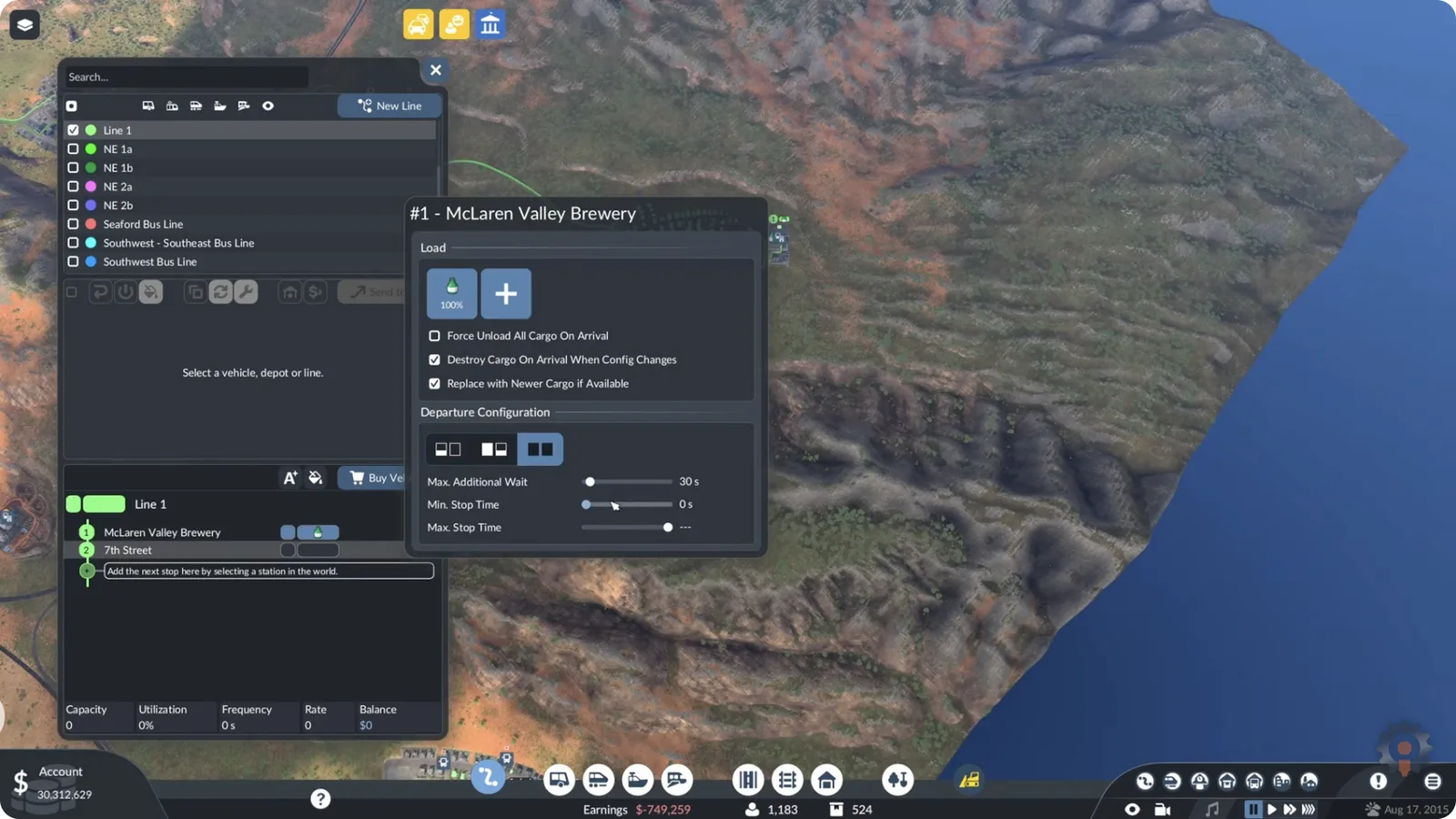
The Drinks filter and full-load departure option belong to the festival supply line.
Inspect the receiving station's coverage of the garden or event location. A delivery stop near the city center is not automatically the right receiver. Confirm the task's destination before sending the first loaded vehicle.
Use a vehicle that carries the specified drinks and configure its loading stop accordingly. The demonstrated route uses full-load departure, but that setting is not a substitute for selecting the right cargo and final receiver. Follow the delivered count rather than the amount waiting at the brewery.
Check for the festival's completion or celebration dialogue after delivery. That confirms the side task; the voter objective remains a separate result. Keep the district services running while the festival connection operates so that completing Cheers does not leave the main task below its conditions.
Hold the district results until all voters are convinced
Revisit the weakest conditions as support approaches 100%. Check numeric thresholds, passenger waiting, freight timeliness, and district traffic again. A district that qualified earlier can deteriorate when the growing or altered network places more load on the same service.
Confirm the final voter result and the star deadline, then check Cheers separately. For detailed bottleneck diagnosis, use Traffic Congestion and Noise and Pollution. For the earlier island campaign and its railway medal, see Mission 6.