
Win Oil for the People by delivering 1,000 oil to the inland refinery before Astrid. Finding oil and building platforms are preparation; the delivery counter decides the race. For two stars, finish before Astrid delivers 750 oil. For three stars, finish before she delivers 500. The separate medal objective is Rescue Lasse, the lighthouse keeper.
Mission 5 takes you to the Ekofisk oil fields in Norway. The difficult part is keeping a complete sea-to-land transport chain moving while construction, production and your competitor compete for attention. Build one useful chain first, then expand the part that is actually holding it back. A second platform does little for the race if the first platform already has oil waiting for a tanker.
Mission objectives and the order to tackle them
| Stage | What you need to accomplish | What to check before moving on |
|---|---|---|
| Prospecting | Find usable offshore oil reservoirs | Let each test drill finish; note which locations are productive |
| Platform construction | Deliver 125 steel to the dry dock | Steel must arrive at the required destination |
| Oil race | Deliver 1,000 oil to the inland refinery | Check delivered oil, not only extracted or stored oil |
| Lighthouse rescue | Bring Lasse back to the mainland | Use a passenger-capable boat for the rescue task |
| Production improvements | Bring workers or machinery when useful | Improve the bottleneck rather than every leg at once |
The star conditions are competing deadlines, not additional quantities you must deliver. Your target remains 1,000 oil. Astrid's counter tells you how much time remains for the better result. Watch both counters throughout the delivery stage, especially before committing money to another long construction project.
Prospecting: finish test drills and choose a workable start
Use the survey ship to investigate the marked offshore locations. Move it to a buoy, anchor and begin the test drill. Wait for the result before sending it somewhere else. An unfinished survey does not establish the reservoir you need for a platform.
The marked locations include straightforward prospects and prospects in Astrid's territory. Red-marked locations require attention to her patrol boats; a promising reservoir is less useful if reaching it takes repeated detours or interruptions. Pick your next investigation by its practical access as well as the potential result.
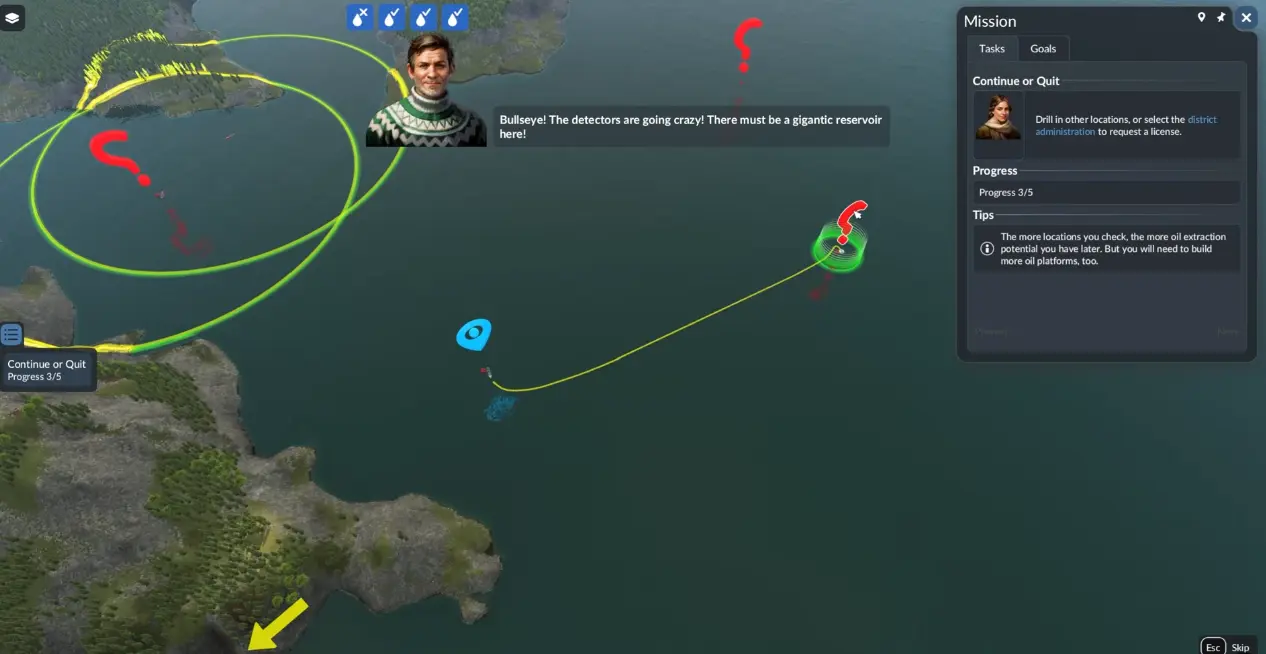
The prospecting screen shows several possible investigation sites. Find productive reservoirs before committing to the extraction license.
More successful investigations give you more places from which to extract oil later. They also create additional platform and transport commitments. Avoid treating every remaining buoy as an automatic requirement. Once you have viable production locations and can see how to connect them to shore, move toward the license application instead of delaying the entire delivery network.
There is no universal buoy coordinate that this walkthrough promises will win your race. Use the mission's current markers and completed test results. This keeps the plan useful when the ship position, patrol movement or your previous choices differ from the illustrated run.
Before applying, consider the shipping leg you are about to build. Which shore transfer will receive the oil? Where will the inland vehicle load? Can the route reach the refinery without a large unfinished rail project? Thinking through these connections now reduces the chance of producing offshore oil with nowhere useful to send it.
Deliver 125 steel to the dry dock
The dry dock needs 125 steel to build the offshore platforms. The objective advances when the steel reaches the dry dock. Having 125 steel at the producer or at an intermediate warehouse does not finish this stage.
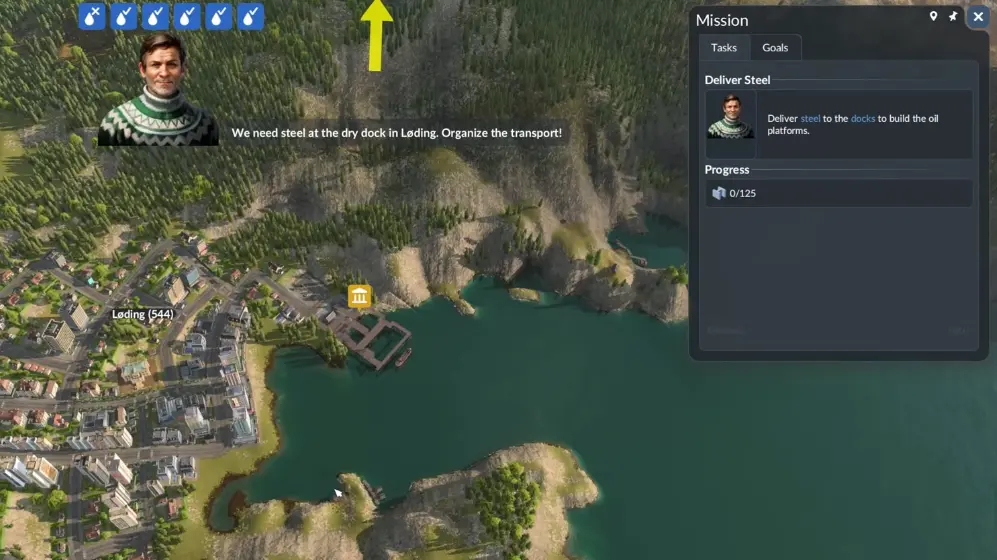
The construction task explicitly asks for 125 steel. Follow the delivered quantity while setting up the route.
Trace a complete route from the steel source to the dry dock. If you use both rail and road, the transfer between them needs a working cargo connection and suitable warehouse storage. Check the cargo types on the vehicles before buying them: passenger vehicles and vehicles restricted to another cargo class cannot move the steel simply because they share the same track or road.
The land corridor can involve steep terrain and existing passenger traffic. Start with a route that can deliver steel reliably. If your freight train repeatedly waits behind the passenger service, inspect the section where the delay occurs. A useful passing opportunity or a better connection can help more than rebuilding the entire corridor before any steel arrives.
Diagnose an empty vehicle in order:
- Confirm steel is available at the source.
- Check that the loading point connects to the source or its working transfer storage.
- Confirm the purchased vehicle can carry steel.
- Check that its line reaches the required destination.
- At a transfer, verify the next leg can load the same cargo.
After the first delivery, watch whether the number rises steadily. Buying more vehicles before fixing an empty loading point repeats the same problem at a greater cost. Keep the construction stage focused on finishing the 125-steel requirement and getting the platforms ready for oil transport.
Build the first complete oil route
Your essential chain is oil platform → tanker → shore transfer → inland transport → refinery. Each arrow must work. A ship full of oil waiting at the wrong shore stop does not contribute to the refinery's delivery counter.
Choose an oil-capable vessel and make its line visit the productive platform and the intended shore unloading point. On land, use vehicles compatible with liquid cargo. If you choose a train, check the wagons as well as the locomotive. The locomotive's speed or power does not make an unsuitable wagon carry oil.
At the shore transfer, inspect the warehouse and connected terminals. Oil is liquid cargo, so a visually large warehouse alone is not evidence that the right storage is present. Ensure the incoming ship and outgoing road or rail line can both use the transfer. Watch the first arrival and departure before duplicating the fleet.
You do not need the final, largest version of every route before beginning deliveries. A smaller working chain starts moving the counter and gives you a clear view of the next constraint. Expand after observing where oil accumulates rather than deciding every fleet size at the start.
| What you see | Likely area to inspect | Useful next action |
|---|---|---|
| Oil waits offshore while ships are away | Shipping cycle or vessel capacity | Check route length and loading before adding a tanker |
| Ships arrive full but oil piles up onshore | Inland transport | Inspect land vehicle capacity, frequency and path |
| Land vehicles depart empty after ship deliveries | Transfer connection or cargo compatibility | Check warehouse class and the loading terminal |
| Ships repeatedly leave with little oil | Platform output or service timing | Inspect production before expanding transport |
| Trains spend much of the journey waiting | Rail access and traffic | Inspect the actual waiting section and available paths |
These are starting points for inspection. Storage alone does not prove a single cause: a disconnected transfer and an infrequent train can both produce an onshore queue. Observe one complete cycle to distinguish them.
Rescue Lasse while the oil route operates
The lighthouse keeper is stranded and needs transport back to the mainland. Use a passenger-capable boat for this objective. An oil tanker serving nearby platforms does not become a passenger rescue vessel merely because it can reach the same waters.
Read the active rescue task, reach the lighthouse pickup and complete the mainland return. Keep the oil service operating while you deal with the side objective, so the rescue does not require pausing the entire delivery chain.
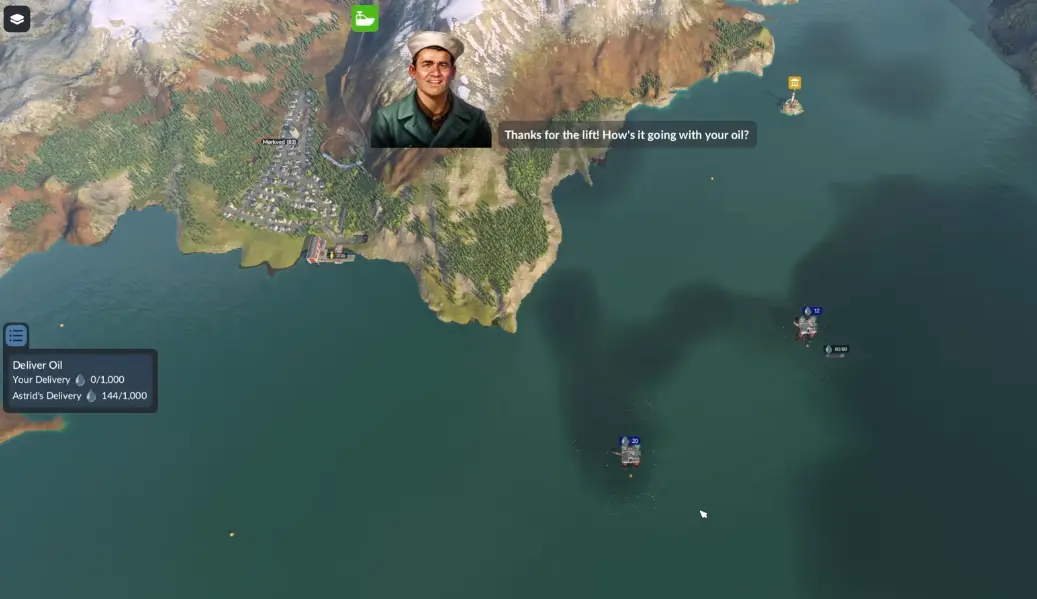
Lasse's dialogue confirms the rescue in the illustrated run. The medal task involves bringing him back, rather than only reaching the lighthouse.
The mission's follow-up includes an improvement to ship speed. That makes the rescue worth handling before the final oil deliveries become urgent. Check the task's completion and follow-up dialogue; do not assume approaching the island alone has triggered the reward.
The rescue boat and the oil tankers solve different problems. Keep their cargo and passenger roles separate when checking an empty vessel, and return your attention to the refinery counter once the rescue is complete.
Add workers or machinery only when production needs help
Later opportunities let you transport workers to the offshore platforms and support drilling improvements with machinery. These can improve production, but the benefit depends on what is currently limiting deliveries.
If a platform has substantial oil waiting between tanker visits, its output is already ahead of shipping. Increasing production in that situation leaves more oil offshore. Improve the tanker cycle or the shore-to-refinery leg first. If ships arrive regularly and find very little oil, worker transport becomes more relevant.
For worker transport, think through the passenger chain from the settlement to its harbor and onward to the platform. A ferry route still needs access to the workers at its shore end. Check that the service carries passengers before expecting the platform to benefit.
The machinery option introduces another supply chain. Read its current requirements and identify the steel, plastic, machine production and final platform delivery connections before building. It can be worthwhile when extraction is the constraint and the race still has room for the investment. It is less useful when enough oil already exists to finish the target but is waiting for transport.
Avoid splitting attention between two unfinished expansions. Complete the improvement most directly connected to the observed bottleneck, watch its effect, then decide whether the second is still necessary.
Finish the race and protect the remaining star target
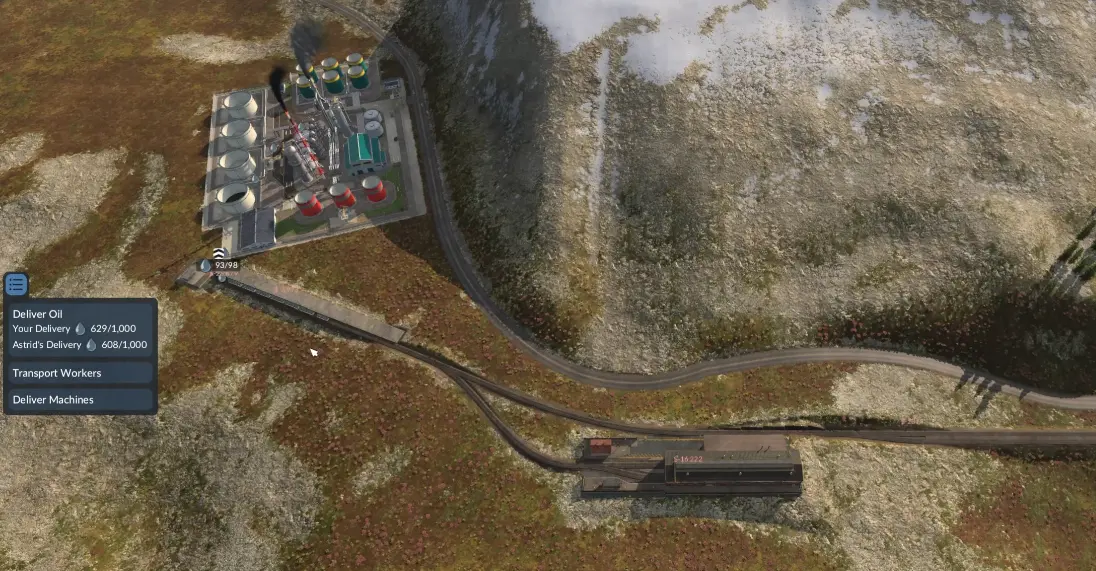
The race display compares delivered oil on both sides. This example is already beyond Astrid's 500-oil threshold, so it does not illustrate a three-star finish.
As you approach 1,000, focus on the oil that can arrive soonest. Keep productive platforms served, keep the shore transfer working and let the inland fleet complete its cycles. A new offshore route with a long construction delay may contribute less than removing a delay on the chain already delivering oil.
If Astrid has passed 500, the three-star condition is no longer available in that run. You can still pursue two stars if you finish before she reaches 750, or complete the main race by beating her to 1,000. Use the live counters to decide whether an expansion has time to pay off.
Before considering a restart, distinguish a lost star threshold from a broken network. A chain that is now delivering steadily can still complete the mission even after missing the best rating. If you restart to pursue three stars, change the setup delay or the limiting transport leg you identified, rather than repeating the same larger network with the same bottleneck.
The dependable plan is to finish the steel stage, establish one complete refinery delivery chain, rescue Lasse and expand against observed queues. That sequence gives each construction decision a purpose in the race.