

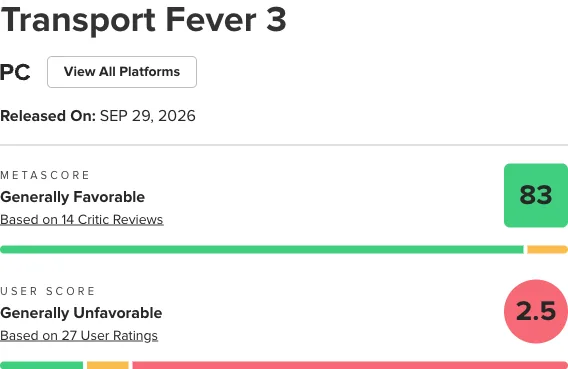
The Transport Fever 3 Metacritic entry shows a PC Metascore of 83, while its PC User Score is 2.5 in the 9 October 2026 snapshot. The first summarizes 14 critic reviews; the second comes from 27 user ratings. They measure different groups of opinion on different scales. The user ratings do not contribute to the Metascore, so the two figures should not be combined into a supposed overall rating.
Start by selecting the platform you intend to play, then read the review count and the comments behind each score. This page explains the PC figures and how to use them. It does not supply a verified console score, a current patch assessment, or a prediction of how the game will run on your computer.
Read the PC score snapshot
Keep the score label, platform, sample size and date together when copying a figure. Without those fields, an isolated number can easily be mistaken for another platform's rating, a user average, or a newer result.
| PC field | Dated value | Meaning |
|---|---|---|
| Metascore | 83 | Weighted aggregate of published critic review scores on a 0–100 scale |
| Critic review count | 14 | Reviews represented in the displayed critic aggregate |
| Positive critic reviews | 13, displayed as 93% | Most of this critic sample falls in the positive group |
| Mixed critic reviews | 1, displayed as 7% | One review falls in the mixed group |
| Negative critic reviews | 0, displayed as 0% | No negative critic review appears in this snapshot's breakdown |
| User Score | 2.5 | User-rating average on the separate 0–10 scale |
| User rating count | 27 | Ratings represented in the displayed user sample |
| Positive user ratings | 4, displayed as 15% | A minority of this user sample is positive |
| Mixed user ratings | 2, displayed as 7% | Two ratings are in the mixed group |
| Negative user ratings | 21, displayed as 78% | Most of this user sample is negative |
These counts describe the people represented on this particular page. They do not count everyone who bought Transport Fever 3, and the percentages are not a survey of the game's entire audience. The critic total and user total also describe different kinds of entries: published reviews and visitor ratings.
Select the platform before comparing scores
Open the game's entry and use its platform selection or platform-specific review links. Open the PC critic review view and confirm that it identifies PC when checking the 83 figure above. The user-review link associated with this snapshot also selects PC. A game page can list several supported platforms while showing one platform's score in its main summary.
Do not carry the PC result over to PlayStation 5 or Xbox Series X simply because all three names appear in the game's details. Platform review sets can differ, and a review about one version does not establish how another version performs. A platform logo beside a score or the platform parameter in a review link helps identify the relevant set.
If a platform's view does not provide a usable score, leave that result unknown. Do not replace it with the PC average or treat a pending value as zero. For a console purchase decision, read the selected console's own reviews and their dates. This guide's numerical table is deliberately limited to the PC data that could be confirmed.
Understand the weighted critic score
Metacritic combines published critic scores using a weighted average. Publications do not necessarily make equal contributions to the result. The service assigns different importance to sources based on factors such as review quality and standing. For games, the review scores come from the publications themselves; Metacritic does not invent a game score for an unscored review.
This is why a quick arithmetic average of a few visible review cards is not a reliable way to reconstruct 83. Those cards may be only part of the review set, and equal weighting is not the described calculation. Use the displayed aggregate for the Metascore and the individual reviews to understand what their authors evaluated.
The score also differs from the share of positive reviews. Thirteen positive reviews out of fourteen explain the displayed 93% positive breakdown, but that percentage is not the Metascore. One summarizes categories; the other summarizes weighted numerical review scores. A positive review can still contain criticism, and a mixed review can still identify features its author enjoyed.
User ratings remain outside this calculation. Adding a user review may change the visitor-side sample, but it does not add another published critic score to the Metascore. Keep the two channels separate when discussing a score change or comparing their counts.
Read the rating breakdown with its sample size
The strongest contrast in this snapshot is the distribution: 13 of 14 critic reviews are positive, while 21 of 27 user ratings are negative. That establishes disagreement between the displayed groups. It does not explain the cause of the disagreement on its own.
The counts matter because percentages can make a small set look more comprehensive than it is. Four positive user ratings are displayed as 15%; the same panel contains only 27 ratings in total. The remaining categories are two mixed and twenty-one negative. Do not describe the 78% negative share as the percentage of all players who dislike the game.
Likewise, the critic panel's zero negative reviews applies to this recorded set. It does not mean nobody published criticism, nobody encountered a problem, or every critic recommended the game without conditions. Read the reviews to distinguish a broadly favorable verdict from a report that every feature works perfectly.
When comparing another score page, check both sample sizes before comparing the percentages. A larger user-rating count elsewhere does not make the two audiences interchangeable. Platform, date and the kind of rating still matter. Keep those differences visible rather than using one percentage to declare which community is correct.
Interpret the gap without inventing a cause
An 83 Metascore and a 2.5 User Score can coexist because they represent different contributors. Converting 83 out of 100 to 8.3 out of 10 only aligns the numerical scale; it does not turn critic and user opinions into one measurement. Averaging 8.3 and 2.5 would create your own number, not a Metacritic score.
The gap is a reason to inspect the underlying comments. It is not, by itself, evidence of review manipulation, review bombing, a broken scoring formula, or a coordinated response. Those explanations require evidence beyond an aggregate and a few negative comments. The available data supports the narrower conclusion that these two displayed groups reached different assessments.
The recorded user comments provide examples of the concerns behind some low ratings. One writer discusses interface scale, large windows and difficulty monitoring several systems at once. Another focuses on whether the sequel offers enough change from Transport Fever 2. A third reports stutter, performance variation and several frustrating interactions. These are individual accounts, not independently reproduced test results.
Use those examples to decide what to investigate next. If interface behavior is important to you, look for a detailed review that shows the relevant menus. If performance is the concern, look for the exact platform, hardware, settings and game version. A user's high-end graphics card or an isolated frame-rate claim does not establish the same outcome on another system.
Read critic reviews and user comments for different details
The critic aggregate is useful for finding published reviews, but the number alone cannot tell you whether a review's priorities match yours. Open the review list and read beyond its score. Look for the mode played, the platform, the depth of the save, the controls used, and the specific limitations the author describes.
Do not treat an attractive score as a performance guarantee. A review can praise network building while still criticizing a menu or a technical issue. Check whether a reported issue affected the author's final verdict, whether the conditions are described, and whether the review date belongs to the launch period or a later assessment.
User comments can surface detailed frustrations, but their usefulness depends on what they actually explain. A comment identifying a particular interaction gives you a concrete question to investigate. A low score with no context gives you less help deciding whether the same issue would affect your play. Neither kind of comment becomes an official bug report simply by appearing beside the aggregate.
Avoid selecting only the comments that agree with the decision you already want to make. Read across the displayed positive, mixed and negative groups when available, then separate specific observations from broad preference judgments. The recorded negative examples are not a complete summary of all twenty-seven ratings, and this page does not claim to have independently tested their reported problems.
Compare snapshots without assuming a patch fixed the game
Scores and counts can change as the review set changes. The figures here are dated values, so check the same platform and score label when returning later. Record the new review count along with the new score rather than comparing two detached numbers.
A higher later score would not, by itself, prove that an update fixed performance or interface behavior. A lower score would not prove that a new patch caused a regression. Establishing either claim requires version-specific evidence about the game. A changing aggregate describes changing recorded opinion; it is not a changelog or a benchmark.
Review dates and game-version dates also serve different purposes. A comment posted after release can describe an earlier session, and a recent page capture does not establish which build each contributor played. If the review does not identify a build, keep that limitation when discussing a technical claim instead of assigning it to the latest patch.
Use the scores to choose the next investigation
For a buying decision, use the game review to examine the transport sandbox, learning curve and reported technical experience. Use the Transport Fever 2 versus 3 comparison if your main question is whether the sequel changes the systems you already know. Use the performance guide after identifying a problem in your own save.
The Metacritic table serves a narrower task: identify the PC critic and user figures, understand how their counts differ, and find the kind of evidence you still need. Keep the snapshot date beside any quoted score and return to the matching platform's review page when you need today's result.