

The Transport Fever 3 industry list contains 32 Free Game facilities. Use the tables below to identify each facility's production rule, listed cargo booster, and available climates before choosing a supply connection. The catalog includes raw-material sites, processing facilities, and factories making goods for towns. Campaigns can contain special industries outside this list.
Production rules show relative inputs and outputs, not a promise of annual throughput. A facility's actual yearly production depends on its state and operating conditions. A climate entry also does not guarantee that the industry is already present on a newly generated map: demand and town development affect which industries appear.
Read the production and climate columns
For a processing rule, + means the inputs are required together, while or identifies an alternative input. Outputs separated by + are products of the same rule, so check all of them rather than ignoring a secondary product.
For raw facilities, the displayed output range is preserved as a range. Do not interpret its upper value as a fixed number produced by every instance of that industry. Raw sites can expand their plots when well served, and blocked or removed plots can limit their production.
The booster column records the cargo booster listed for that facility. Not listed means the catalog does not name a cargo booster; it is not a claim that passenger workers have no effect. Worker connections are a separate production boost and are covered in the industry-workers guide.
Climates are spelled out as Temperate, Dry, Tropical, and Subarctic. Where a climate is absent, do not plan that vanilla facility as a normal industry in that climate. The Quarry's Dry entry is specially marked in the available table and is preserved with that qualification rather than silently converted into unconditional availability.
Raw-material facilities
These facilities supply raw cargo without requiring a regular processing input. Their listed booster goods improve production when supplied sufficiently; they are distinct from the materials produced by the site.
| Facility | Displayed output rule | Listed cargo booster | Climates |
|---|---|---|---|
| Clay Pit | 1–16 Clay | Tools | Temperate, Dry |
| Coal Mine | 1–16 Coal | Tools | Temperate, Dry, Tropical, Subarctic |
| Cotton Farm | 1–12 Wool | Fertilizer | Temperate, Tropical |
| Crop Farm | 1–24 Grain + 1–16 Vegetables | Fertilizer | Temperate, Dry, Tropical, Subarctic |
| Fishing Grounds | 1–12 Fish | Tools | Temperate, Tropical, Subarctic |
| Iron Ore Mine | 1–16 Iron Ore | Not listed | Temperate, Dry, Tropical, Subarctic |
| Logging Camp | 1–8 Logs | Not listed | Temperate, Dry, Tropical, Subarctic |
| Oil Platform | 1–4 Crude Oil | Tools | Temperate, Dry, Tropical, Subarctic |
| Oil Well | 1–6 Crude Oil | Machines | Temperate, Dry, Tropical, Subarctic |
| Quarry | 1–16 Stone | Tools | Temperate, Tropical, Subarctic; Dry marked (✓) |
| Rubber Farm | 1–32 Rubber | Fertilizer | Tropical only |
| Sand Excavator | 1–8 Sand | Machines | Temperate, Tropical, Subarctic |
| Sand Pit | 1–8 Sand | Tools | Temperate, Dry, Tropical, Subarctic |
Two facilities can supply the same cargo while accepting different boosters. An Oil Platform and Oil Well both produce Crude Oil, but their listed boosters are Tools and Machines respectively. Likewise, a Sand Excavator lists Machines while a Sand Pit lists Tools. Match the booster to the facility instead of choosing it only from the output cargo's name.
The Crop Farm supplies both Grain and Vegetables. Grain serves the production network, while Vegetables can be demanded by commercial districts. These are separate uses of that farm's output, so a farm connection should be chosen according to the cargo the destination actually accepts.
Wool can come from a Cotton Farm as well as a Livestock Farm. The Cotton Farm is listed in Temperate and Tropical climates, while the Livestock Farm appears across all four. When planning fabric production outside the Cotton Farm's climates, check the alternative supplier instead of assuming the weaving chain is unavailable.
Fishing Grounds are absent from the Dry column. Rubber Farms are Tropical-only. These distinctions matter before you invest in downstream facilities: a world with plentiful water or open farmland still needs the appropriate climate and actual source industry for the planned cargo.
Processing facilities and factories
These rules identify the inputs required to produce each output. Multiple inputs must reach the same working facility. A source elsewhere on the map does not satisfy a recipe merely by existing.
| Facility | Inputs and outputs | Listed cargo booster | Climates |
|---|---|---|---|
| Brewery | 8 Grain + 3 Glass → 8 Beverages | Not listed | Temperate, Dry, Subarctic |
| Brick Works | 4 Clay → 4 Bricks | Not listed | Temperate, Dry |
| Cement Plant | 4 Stone → 2 Cement | Not listed | Tropical, Subarctic |
| Chemical Plant | 6 Chemicals → 2 Dyes + 5 Plastic | Not listed | Temperate, Dry, Tropical, Subarctic |
| Canning Factory | (2 Fish or 2 Meat) + 1 Sheet Metal → 2 Canned Food | Not listed | Temperate, Dry, Tropical, Subarctic |
| Furniture Factory | 4 Planks + 1 Glass → 2 Furniture | Machines | Temperate, Dry, Tropical, Subarctic |
| Glass Works | 4 Sand → 2 Glass | Not listed | Temperate, Dry, Tropical, Subarctic |
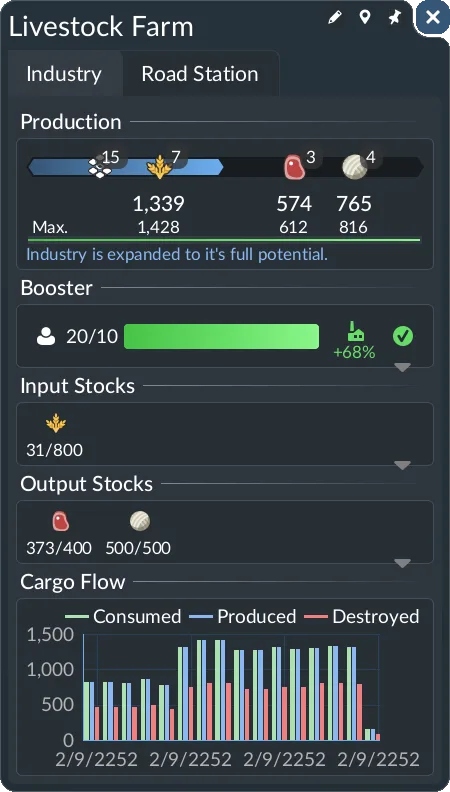
| Livestock Farm | 7 Grain → 3 Meat + 4 Wool | Machines | Temperate, Dry, Tropical, Subarctic |
| Machine Factory | 7 Steel + 4 Plastic → 7 Machines | Not listed | Temperate, Dry, Tropical, Subarctic |
| Oil Refinery | 4 Crude Oil → 2 Fuel + 1 Fertilizer + 4 Chemicals | Not listed | Temperate, Dry, Tropical, Subarctic |
| Paper Mill | 4 Sawdust → 2 Paper | Not listed | Subarctic only |
| Printing Press | 4 Paper + 2 Dyes → 4 Books | Not listed | Subarctic only |
| Saw Mill | 4 Logs → 4 Sawdust + 8 Planks | Not listed | Temperate, Dry, Tropical, Subarctic |
| Steel Mill | 6 Iron Ore + 6 Coal → 4 Sheet Metal + 3 Steel | Not listed | Temperate, Dry, Tropical, Subarctic |
| Textile Factory | 4 Fabric + 2 Dyes → 3 Clothes | Not listed | Temperate, Dry, Tropical, Subarctic |
| Tire Factory | 4 Rubber → 2 Tires | Not listed | Tropical only |
| Tool Factory | 4 Planks + 2 Plastic → 5 Tools | Not listed | Temperate, Dry, Tropical, Subarctic |
| Vehicle Factory | 1 Tires + 4 Sheet Metal + 1 Machines → 1 Vehicles | Not listed | Temperate, Dry, Tropical, Subarctic |
| Weaving Mill | 4 Wool → 4 Fabric | Not listed | Temperate, Dry, Tropical, Subarctic |
The Canning Factory accepts either Fish or Meat for the first part of its recipe, but Sheet Metal remains required. “Fish or Meat” does not make the complete recipe optional. This is useful when choosing between available food sources in a climate without Fishing Grounds.
The Steel Mill produces both Sheet Metal and Steel. The Vehicle Factory needs Sheet Metal, while the Machine Factory needs Steel. A connection serving only one of these outputs should not be treated as a complete description of the mill's possible supply role.
The Oil Refinery also produces several outputs together: Fuel, Fertilizer, and Chemicals. Fuel serves industrial-district demand, Fertilizer is a booster, and Chemicals feed the Chemical Plant. The refinery is therefore a branching production site rather than a facility that makes only the one cargo your tanker currently carries onward.
Check climate-specific production before starting a chain
Some industrial groups are present in every climate, while others are sharply restricted. Use the facility's climate column to check the entire group rather than inspecting only the last factory in a plan.
The Paper Mill and Printing Press are Subarctic-only. The paper-and-books branch therefore needs that climate for its normal vanilla facilities. Sawdust from a Saw Mill does not establish that a Paper Mill will exist in a different climate.
The Rubber Farm and Tire Factory are Tropical-only. The tire branch has a distinct climate requirement even though the Vehicle Factory itself is listed in all four climates. Do not infer that every input for an all-climate factory can necessarily be sourced from a naturally generated local facility in every climate.
Brick Works are listed for Temperate and Dry, while Cement Plants are listed for Tropical and Subarctic. Bricks and Cement are separate products from separate recipes. A Quarry and a Clay Pit are not interchangeable suppliers simply because both appear to excavate materials from the ground.
Brewery is listed in Temperate, Dry, and Subarctic, excluding Tropical. Cotton Farm is listed in Temperate and Tropical. These narrower patterns show why checking a single “available in several climates” label is less useful than reading the actual set of climates.
When a climate-specific site is missing from a world, first distinguish unavailable-by-climate from not-yet-present. The two situations lead to different expectations. An industry permitted in the climate may appear later as town demand grows; an industry omitted from that climate should not be assumed to spawn merely because you wait longer.
Match a named cargo to the right facility
Use the directory from the facility side: identify the building, then read what it consumes and produces. If you start with a cargo name instead, the cargo-types directory provides the producer and consumer index without requiring you to inspect every recipe.
For Glass, find Glass Works and its Sand input. The glass can then serve a Brewery or Furniture Factory. A cargo name containing a manufactured material does not mean every processing site can make it.
For Plastic and Dyes, find Chemical Plant and its Chemicals input. Both are outputs of the same rule, but their consumers differ. Plastic supports the Tool and Machine factories; Dyes support textile production and the Subarctic printing branch.
For Tools, find Tool Factory, requiring Planks and Plastic. The produced Tools are used by industrial districts and by specific boosted raw industries. A tool-producing facility is not the same object as a game's construction-tool menu or a community software utility.
For Vehicles, find Vehicle Factory and its three inputs: Tires, Sheet Metal, and Machines. Vehicles here are cargo produced for industrial-district demand. They are distinct from buses, trains, or aircraft that your company buys in a depot to operate a line.
Use the table alongside the selected industry's window
Select the actual industry before committing transport capacity. Its Production section shows the rule, recent consumed and produced quantities, and theoretical annual maximum. These provide the instance-specific context that a fixed catalog cannot supply.
Keep production inputs, cargo boosters, and passenger workers separate. A processing input is part of the output recipe. A listed booster is an additional production aid. A passenger connection supplies workers. They do not become substitutes for one another because they all arrive at the same industrial site.
The directory's booster entries and the cargo-consumer index are not always equally explicit. In particular, Machines are named as a consumer relationship for some sites whose industry-table booster cell is blank. Not listed preserves that gap; inspect the site's actual Booster section before treating the blank as proof of no acceptance or planning an unverified bonus.
For production, inventory, expansion, or industry closure diagnosis, continue with Industries. For the inverse lookup by cargo, use Cargo Types. For building the multi-step transport connection between these facilities, use Cargo Chains.