
Transport Fever 3 mission 4 takes place in Bethel and asks you to prepare the Biggest Festival Ever, then bring the band to the stage. Completing the concert with 500 attendees earns one star, 750 earns two, and 1,000 earns three. The optional medal comes from finding the instruments. Build for the attendance target while preserving enough cash to respond when the story introduces urgent medical deliveries.
The difficult part is the sequence of changing supply tasks. Stage timber comes first, followed by food, toilets, sewage disposal, medication, blankets and the final helicopter transport. A route that completed an early task may be available for reuse later. Keep watching the active objective and the campground's needs instead of spending the entire opening budget on a single impressive construction project.
Set the attendance target before the opening
| Result | Required concert attendance |
|---|---|
| One star | 500 attendees |
| Two stars | 750 attendees |
| Three stars | 1,000 attendees |
| Optional medal | Find the instruments |
The goal is the attendance when the concert starts. Reaching 500 does not finish every preparation task, and finding the instruments does not substitute for the larger attendance target. Work on campground access and supply while the stage is being built so that growth is already underway when the final transport becomes available.
This mission does not provide ordinary loans in the walkthrough. Reserve cash for vehicles that later tasks will need, and avoid interpreting every suggested expansion as essential. The demonstrated opening uses a railway and helicopter timber relay, which works but ties up considerable money. Its useful lesson is to complete the stage supply chain and recover temporary vehicle spending afterwards, rather than matching every construction exactly.
Deliver stage timber through a complete chain
The first task is to bring logs from the logging camp to the stage. The demonstrated route places a small cargo railway station at the logging camp, connects it to the existing railway and uses a short freight train to carry the logs to a transfer location. The stage is served by a helicopter landing facility, so the final leg uses a cargo helicopter.
Check catchment before buying the train. In the walkthrough, the first line did not automatically recognize logs because the pickup station was outside usable coverage. Moving the connection repaired that problem. A station beside the industry is not enough if its access does not actually include the logging camp. Confirm the origin and load before adding vehicles to the relay.
At the transfer end, use a warehouse connected to the relevant facilities and configure the intended cargo. Create the helicopter line to the stage and assign an aircraft that can carry logs. The demonstrated helicopter waits for a full load to avoid repeatedly flying with very little cargo. Follow a complete train delivery and helicopter pickup to verify that the timber reaches the stage objective.
Help the campground grow while timber moves
The campground behaves as a populated area with transport and supply needs. Provide roads for the area where you expect it to expand, then create local bus coverage. The walkthrough uses clockwise and counterclockwise campground services and later adds connections from outside the grounds. Those routes are tools for accessible passenger journeys, rather than a requirement to copy a particular road ring.
Inspect coverage again as tents and buildings spread. A stop that served the early campground may leave new areas outside reach. Add or move stops when the coverage shows a gap, then update the relevant line's stop list. A growing attendance target needs an accessible transport network across the actual campground, not just a bus route at its original edge.
Keep buses affordable and expand with observed demand. The guide demonstrates that buses become useful as visitors travel within the grounds and to surrounding areas. At the same time, buying a large fleet before the initial food and stage deliveries can leave too little money for the later emergency. Establish useful service first, then strengthen it as queues and finances justify the change.
Supply canned food and vegetables
The next food request introduces the nearby canning factory. Create delivery lines from its accessible pickup to distribution stops covering the campground. The demonstrated approach uses more than one drop-off location to serve the growing area. Check each drop-off's coverage rather than assuming that unloading at the nearest edge supplies every tent.
Vegetables then become another requirement. The walkthrough uses the existing ports to carry salad by ship, followed by truck distribution from the arrival transfer to the campground. Make the whole chain work: farm-side access, a compatible vessel, usable arrival facilities and trucks carrying the salad to covered destinations. The ship reaching port is only the middle delivery.
A specialized warehouse at the transfer preserves the salad's delivery time while it waits there. That helps the maritime relay, but the final trucks still need to move the goods to the campground. Inspect their pickup and departure settings. A truck waiting indefinitely for a full load can become a delay when the available shipment is smaller than its capacity.
Once the stage has enough timber, reconsider the temporary timber vehicles. The walkthrough sells the train and helicopters used for construction and redirects money towards food deliveries. Do not delete a shared facility that another active chain needs. Recover spending from completed temporary work deliberately, after confirming the relevant stage task is satisfied.
Place toilets and establish collection
Place the requested toilets when the story asks for them. Their existence is only the first sanitation step: growing attendance produces a sewage transport requirement. Create a line calling at the toilets and the requested disposal destination, and use vehicles compatible with sewage.
The demonstrated collection route visits three toilets before unloading. Its load targets rise across the pickups, allowing the vehicle to collect portions from several locations instead of demanding a complete load at the first toilet. If you use a multi-stop collection route, inspect what the load settings require at each stop and whether they permit the vehicle to continue collecting.
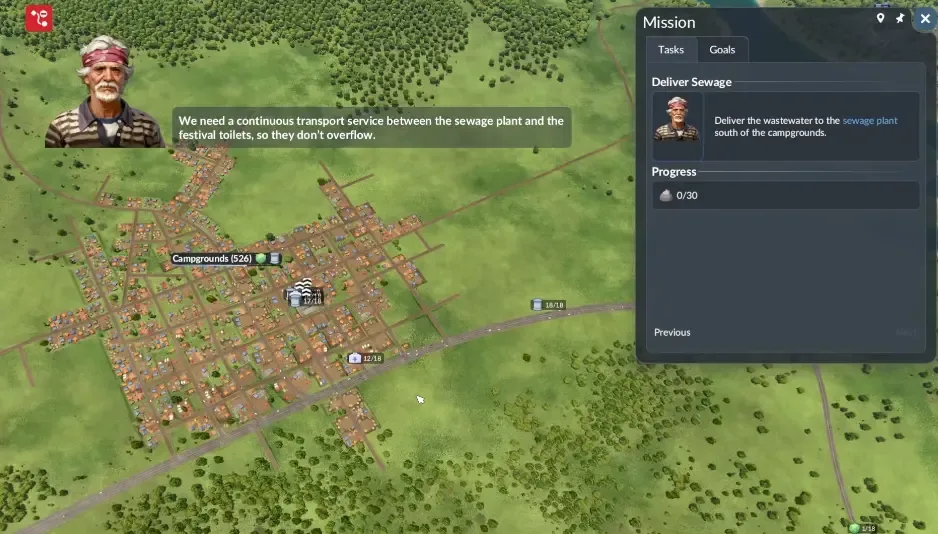
Watch the toilet storage and collection cycle. A truck that is technically assigned but delayed in traffic or waiting at one pickup is not clearing the other locations. Add collection capacity when storage keeps growing, and check that the destination unloads the sewage. This becomes more important as the campground approaches the attendance needed for three stars.
Respond immediately to the medication emergency
The story later reveals illness among visitors who bathed in the polluted river. The sheriff demands medication from the pharmacy in Bethel. This is the time-sensitive delivery in the walkthrough: failing to complete it within the displayed countdown loses the mission. Pause to organize the response and follow the medicine objective rather than continuing routine food expansion first.
Create a medication line from the pharmacy to a covered campground destination. A nearby road depot reduces the initial repositioning distance for new trucks. Purchase compatible vehicles with the cash available, and inspect existing compatible trucks that can be reassigned temporarily. The demonstrated run redirects some food-delivery vehicles to medicine to get sufficient capacity moving promptly.
Confirm that medicine is loading and watch the first arrivals. A large fleet at a distant depot is less useful than vehicles already able to pick up at the pharmacy and reach the campground before the timer expires. Increase the service when the objective still needs more deliveries, while keeping track of the reduced food service caused by reassignment.
At this stage, change the sewage destination from the river dump to the sewage treatment plant as the story directs. The ongoing disposal service will be required after the medication emergency. Update the stop and confirm the existing collection trucks can reach it. Continuing to unload at the earlier dump does not satisfy the new treatment requirement.
Restore the permanent campground services
When the medication target is complete, inspect the temporary medicine fleet. The walkthrough recovers money from surplus vehicles and strengthens the food and bus services. You can also return compatible reassigned vehicles to their earlier routes. Make the choice according to the supplies and queues still visible at the campground.
Keep the treatment-plant collection operating. The story requires continuous transport between the toilets and the sewage plant so the toilets do not overflow. This is an ongoing sanitation service rather than a one-time batch that you can stop after the first unloading. Follow the collection route and confirm that every toilet continues to be served.
Review canned food, salad and passenger coverage together. An attendance problem can involve missing supply as well as missing access. More buses will not deliver salad, and more food trucks will not repair a passenger stop outside coverage. Use the campground's displayed needs to decide which service is the present constraint.
Find the instruments for the medal
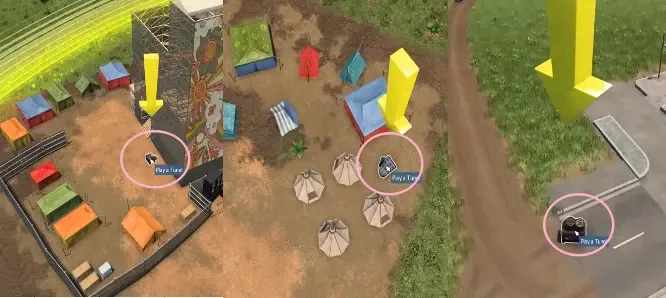
When the opening act's instrument truck gets stuck, the story asks you to find borrowed instruments. Pause and inspect the stage and its immediate surroundings. The recorded solution finds two instruments on the stage area and a third in front of it. The final location is easy to miss if you search only within the platform itself.
Click the relevant objects and watch the objective update after each selection. Continue until the instrument task confirms completion. This is a separate optional medal goal, so do not infer success merely because the audience has reached 1,000. Likewise, collecting the objects does not finish the blanket supply or the final headliner transport.
Deliver blankets when the storm arrives
The sheriff's storm warning introduces a request for blankets from the nearby textile factory. Create the supply chain from that factory to the campground. The demonstrated solution uses rail transport to a transfer near the grounds, then truck distribution to the delivery area. Some infrastructure from the timber phase can be reused, provided its access and cargo settings now fit textiles.
Configure the transfer storage and compatible vehicles, then follow the first shipment. Watch which stop the train visits first: in the recording, an initial wrong-direction trip delays the load. The route needs to pick up blankets at the factory and deliver them to the transfer before the final trucks can help the objective.
The narrator initially calls the blanket task time-sensitive, then corrects that statement after inspecting the task: it does not have the medication emergency's countdown in this run. Use the task panel in your mission to distinguish those conditions. Deliver the required blankets, but do not invent an emergency timer based on the earlier commentary.
Bring the headliners by helicopter
Once preparations are complete, the headliners refuse to walk through the mud and request air transport. The story supplies the police helicopter for the final movement. Create or update the appropriate passenger line from the hotel pickup to the stage landing facility and assign the provided aircraft.
The recording initially selects the wrong pickup, then corrects it to the hotel. That is the key final check: use the mission-highlighted hotel location, rather than an arbitrary nearby town landing facility. Confirm the helicopter actually picks up the band and flies to the stage. The mission ends with its arrival and the concert beginning.
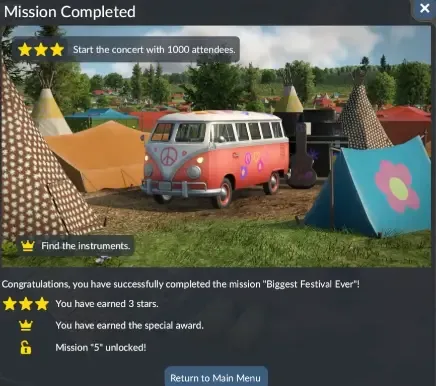
The result screen confirms the attendance and optional instrument goals after the final transport.
Before allowing the final trip to complete, check the attendance target you are pursuing and the instrument medal. For three stars, the concert needs 1,000 attendees. Keep the useful food, bus and sanitation services running while you finish preparations so that the audience is ready when the band lands.
If the run stalls
If the stage receives no logs, inspect the logging-camp catchment and the transfer between train and helicopter. If food arrives at port but campground supply remains poor, follow the final truck leg and its drop-off coverage. If toilets overflow, inspect every pickup and the current treatment destination rather than adding a truck without checking the route.
For the medicine emergency, prioritize actual pharmacy pickups and completed arrivals before the timer expires. For the final concert, distinguish three separate requirements: finished preparations, the chosen attendance threshold and the optional instruments. Completing one does not automatically establish the others. Check the active objective after each story change, because this mission repeatedly changes the job your network must perform.