

Transport Fever 3 helicopters can carry passengers or cargo between suitable landing facilities, but the best model depends on the job. Start with the load you need to move, choose a helicopter that supports it, then compare capacity, rated speed, loading, comfort and running cost. A larger aircraft can reduce the number of departures required without improving every other part of the service.
To open a route, provide a heliport with its integrated helicopter depot, connect suitable destinations, create the line and purchase a compatible helicopter. A smaller helipad provides landing and take-off rather than a vehicle store. Keep that distinction clear: a place where helicopters can call is not necessarily a place where you can buy them.
Set the purpose before placing facilities
A passenger service and a cargo service need different checks before the first aircraft leaves. For passengers, the landing facility needs useful access to the origins and destinations the residents want to reach. For cargo, the network must provide a complete path from the producer to an accepting destination, including any transfers before and after the flight. Aircraft do not create a load merely because two terminals are connected.
Choose one opening task that you can inspect. A small passenger feeder needs enough seats for the observed demand. A freight connection needs the correct cargo support and enough delivery capacity. Treat the selected model as a response to that task, rather than making a helicopter route simply because a new model appears in the purchase menu.
Write the task in operational terms: move this passenger flow between these terminals, or clear this quantity of compatible cargo from this pickup. That makes the subsequent choice easier to check. If the queue is tiny, a large cabin adds empty capacity. If passengers or cargo remain behind after every departure, more capacity or more frequent departures has a measurable purpose.
Provide a purchase location and reachable stops
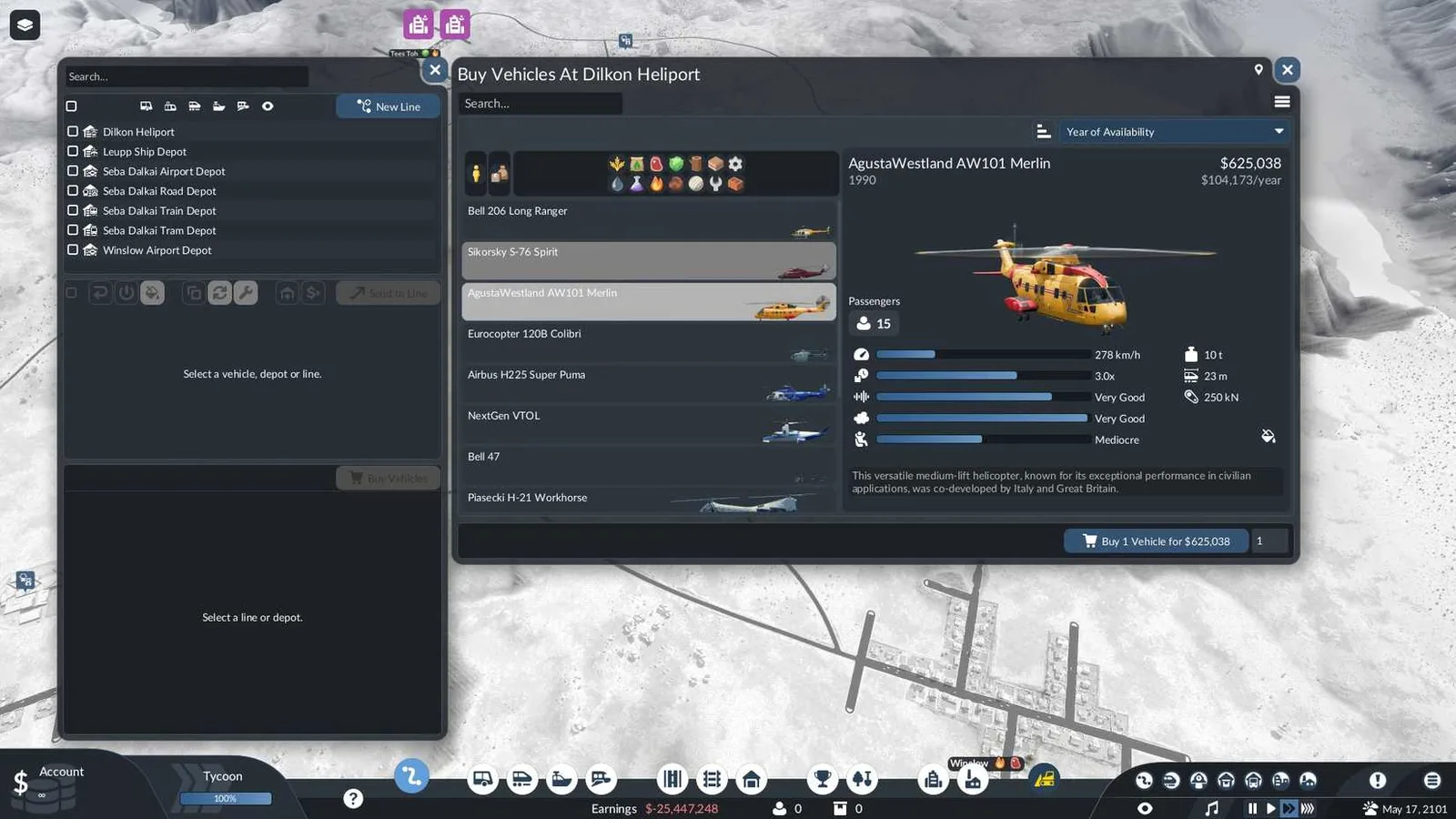
Dedicated heliports contain a helicopter-only depot. Smaller helipads support landing and take-off, while the airport category that supports helicopters also provides another possible calling location. Inspect the actual facility and its available controls before buying. The important requirement for the opening is a purchase location that can send the selected aircraft onto the intended line.
Add the stops in the desired service order. The line should include the complete journey, and its load settings should match the selected aircraft. Use descriptive names for the line and its terminals so that a passenger route and a freight route are easy to distinguish when assigning vehicles. Confirm the first stop rather than assuming that purchasing the model also assigns it to the route you meant to operate.
For passengers, inspect catchment and the surrounding connections. For freight, inspect access to the producers, destinations and transfer facilities. A helicopter can bypass a long ground journey, but it cannot remove the need for a working connection at the two ends. If the flight is only the middle leg, follow the cargo through the arrival transfer before judging the entire service.
Separate passenger, cargo and mixed roles
The vehicle store indicates the supported loads. Passenger helicopters are not substitutes for cargo helicopters when the route needs goods transport. Some models support both roles, but a role icon is not a promise that the displayed passenger and freight capacities are simultaneously available in every configuration. Check the selected load setup and the actual capacity shown for that setup.
This matters particularly when comparing a dedicated passenger aircraft with a multipurpose model. A passenger cabin that is adequate for one service may not provide the freight capacity you expected on another. Compare the correct variant and the configured load, then ensure the line allows that load at its pickup and destination stops.
Use the store's load filters to narrow the list. Availability also depends on the game's year, so a model mentioned in a comparison may not yet be offered in your save. The practical choice is among compatible aircraft you can actually purchase. A future upgrade can be a planning option, but it does not solve the current route's missing capacity.
Compare passenger helicopters by the missing benefit
The Bell 47 provides a small opening option with two listed places and support for passenger and cargo roles. The passenger Bell 206 increases the cabin to eight places. That is a useful change when the route has outgrown very small departures, but it is also a change in the service pattern: one aircraft carries the larger load rather than several small aircraft carrying it separately.
The Sikorsky S-76 raises the passenger figure from eight to ten compared with the Bell 206. Its displayed speed, loading and comfort also improve in the recorded vehicle comparison. This gives several reasons to consider it when a route is struggling with passenger queues or the existing service is too slow. If eight places already meet the load, inspect whether those other improvements justify the extra recurring expense.
The Merlin provides fifteen passenger places, compared with ten on the S-76. The extra capacity is its clear purpose, while the recorded speed, loading and comfort comparison favors the smaller model. A bigger cabin therefore does not settle the replacement decision. Choose the fifteen-seat option when the route needs those places; keep the ten-seat aircraft when its service is adequate and its other properties remain useful.
| Passenger decision | Compare first |
|---|---|
| Very small feeder load | Purchase and annual expense for a small aircraft |
| Queue exceeds each departure | Seats per aircraft and the departure pattern |
| Capacity is adequate, trips feel slow | Complete journey time and rated speed |
| Long terminal time | Loading rating and observed loading time |
| Similar cabin sizes | Comfort, noise, pollution and recurring cost |
Read same-capacity alternatives carefully
The Colibri and Super Puma both offer twelve passenger places in the recorded roster. Their differences are therefore about the cost and quality of providing that capacity, rather than a larger cabin. Compare the upfront expense, annual expense, rated speed and environmental ratings. A route may benefit from one balance while another route favors the alternative.
The Super Puma and Merlin illustrate the next choice: twelve places versus fifteen. The larger model has a clear role if three more passengers per departure repeatedly matter. If twelve already clear the queue, the extra cabin does not establish a benefit by itself. Look at the remaining attributes instead of treating capacity as a single score that ranks every helicopter.
Avoid replacing a satisfactory aircraft on the calendar alone. A later model may change loading, comfort or speed while leaving capacity unchanged, or it may add capacity while weakening another property. Name the shortcoming before you open the comparison. Then verify that the proposed purchase improves that specific row and that the difference is useful on the route.
Choose freight capacity and departure pattern together
Cargo helicopters offer another set of tradeoffs. The Skycrane carries ten cargo units, while the K-MAX carries fifteen in the recorded comparison. The larger load is useful when the pickup repeatedly has more than ten units ready. It does not automatically establish a faster service: the Skycrane has the stronger displayed speed and loading figures in that comparison.
The Mi-26 concentrates thirty cargo units into one departure. Two K-MAX helicopters also provide thirty places across the fleet, but those are two separate fifteen-unit departures. Three Skycranes reach thirty places through three ten-unit departures. These totals describe available space, not equal trip time, equal throughput or equal revenue.
A single large aircraft may suit a concentrated load. Several smaller aircraft may suit a service that benefits from separate departures. Include annual vehicle expense and the actual loading and flying cycle in the comparison. Adding the loading multipliers of several aircraft does not demonstrate that a terminal will load the fleet several times faster; each aircraft still handles its own load.
Configure the flight as part of the delivery chain
Open the line manager and check pickup, unloading and departure conditions at each stop. A freight line can take what is available or wait for a fuller load, depending on its settings. Select the behavior intentionally. Waiting may concentrate cargo into a useful departure, but it can also leave a working aircraft sitting at a terminal while another part of the chain needs a delivery.
For mixed-load aircraft, distinguish a condition that waits for any supported compartment to fill from one that expects all configured loads. Do not let a departure rule demand cargo that the pickup cannot provide. Start by carrying the intended cargo on a straightforward line, then add more complicated load rules after you have observed a complete delivery.
Delivery time is another part of the freight assessment. A fast flight does not prove the whole chain is timely if the cargo waits at the origin or after landing. Follow the item through the feeder, flight and final distribution. Improve the slow stage you can observe, rather than assuming the helicopter's rated speed fixes every delay.
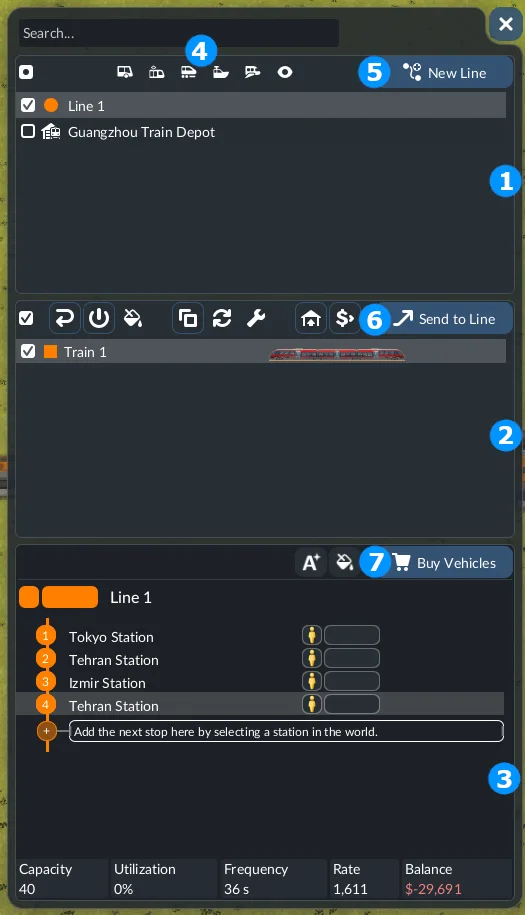
The shared line manager is shown with a railway service; use the same stop and load checks on the helicopter line.
Commission one aircraft before expanding
Run the first helicopter through a complete service cycle. Watch it leave the purchase facility, reach the selected pickup, load the intended passengers or cargo, fly to the destination and unload. This confirms several separate requirements: assignment, reachable facilities, compatible load and a working destination. A vehicle that flies empty has passed only the movement part of that check.
Inspect the queue after departure and when the aircraft returns. A persistent backlog suggests that capacity or frequency needs attention, while an empty pickup needs a different investigation. Check access and the delivery path before purchasing another helicopter. More aircraft on a line with no valid load add expense while preserving the original fault.
Once the route works, compare the line's performance and the aircraft's running costs. Revenue arrives when a passenger or cargo item reaches its destination. Assess repeated trips before expanding the fleet, particularly if the first trip involved a long repositioning flight. One successful delivery establishes function; the pattern over time tells you whether another aircraft has a useful job.
Troubleshoot the service in order
| Symptom | First inspection |
|---|---|
| Cannot buy the intended helicopter | Facility depot, year availability and vehicle compatibility |
| Purchased aircraft is idle | Line assignment, selected first stop and reachable landing facilities |
| Helicopter flies empty | Load role, pickup access and a complete destination path |
| Cargo never leaves the terminal | Departure conditions and permitted loads |
| Every departure is full, queue grows | Capacity and the interval between usable departures |
| Faster aircraft gives little improvement | Waiting, loading and transfers across the complete journey |
Make one change at a time and observe the next complete trip. If you add aircraft, enlarge terminals and alter load settings together, it becomes difficult to tell which change repaired the service. A clear opening route gives you a useful baseline for later expansion and vehicle comparisons.
When a helicopter upgrade is worthwhile
Upgrade when you can describe what the new aircraft fixes. More seats can clear a sustained passenger queue. More cargo capacity can concentrate a larger shipment. Better loading can reduce a terminal bottleneck, while a higher rated speed may matter on the flying leg. Better comfort, noise or pollution can also be a deliberate choice, provided you inspect the relevant ratings rather than substituting real-world aircraft specifications.
The store provides a shortlist; actual trips settle whether the choice works on your network. Keep an adequate helicopter when its load, costs and service pattern already fit the task. Buy a different one when its specific improvement is needed, then check that improvement after assignment. The useful helicopter is the aircraft whose role remains clear once it leaves the purchase window.