Transport Fever 3 train priority controls how railway lines reserve track when multiple services compete for the same path. Open the relevant railway line, use the priority controls in the lower-right corner of the line window, and give the service you want to protect a higher priority than the competing service. The higher-priority line will reserve additional track ahead of time, helping an express or other important service secure a shared section before a lower-priority train enters it.
Priority is a reservation rule, not a speed boost or an automatic overtaking command. It cannot make an occupied track available, invent a passing lane, or repair a junction where a waiting train physically blocks the crossing. For a useful result, the preferred service still needs a continuous route through the conflict, while the other service needs somewhere safe to wait without obstructing that route.
Set train priority on the competing lines
Use this short procedure when a fast or important train repeatedly loses a shared junction, merge, crossing, or single usable path to a less important service.
- Identify the exact railway lines involved in the conflict. Follow each train back to its line rather than changing settings based only on vehicle appearance.
- Open the line details window for the service whose journey you want to protect.
- Find the railway priority controls in the lower-right corner of the window. Train and tram lines have these additional controls.
- Increase the priority of the protected railway line.
- Open the other line that competes for the same track and inspect its setting as well. The useful part of the configuration is the difference between the two services.
- Watch a complete encounter at the shared section. Continue observing after the lower-priority train stops so you can confirm that the protected service passes and the waiting train subsequently resumes its journey.
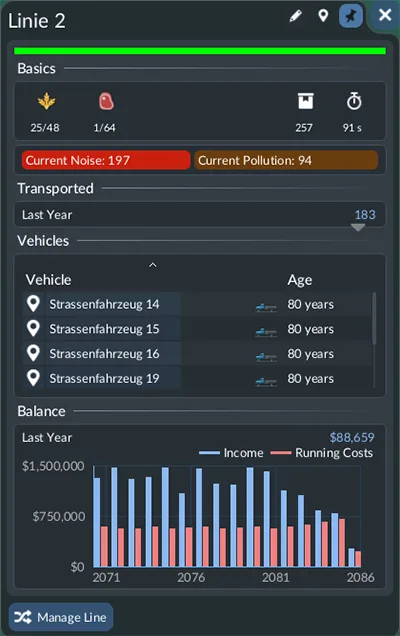
The line details window groups the service and vehicle information.
Do not automatically raise every railway line to the same setting. If all competing lines receive the same high priority, the network loses the distinction that was supposed to protect one journey. Choose deliberately: an express passenger service, a time-sensitive connection, or another operationally important line can receive higher priority while a service that can tolerate waiting remains lower.
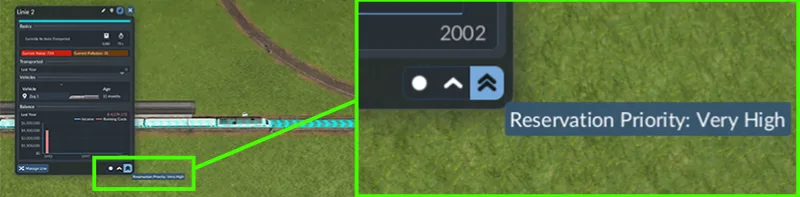
The priority controls used to set a railway line's reservation priority.
How reservation priority changes a conflict
By default, a train attempts to reserve more track when it would otherwise need to brake. That timing can allow a slower regional train to enter a shared section in front of an approaching express. Raising the express line’s priority makes it reserve additional track ahead of time, so the conflict can be settled earlier in favor of that service.
The setting belongs to the line, not to one isolated meeting between two vehicles. Every train operating on that line uses the line’s reservation priority when it approaches relevant track conflicts. This is why the first diagnostic step is to identify both lines correctly and compare their settings.
Priority only influences competition for track that can actually be reserved. It does not change the line’s stop order, create a new route, increase the train’s top speed, or guarantee that a train can pass through infrastructure that is already blocked. If both services have only one physically usable track, one must wait. Priority helps decide which service receives the shared path first; it does not add capacity to the railway.
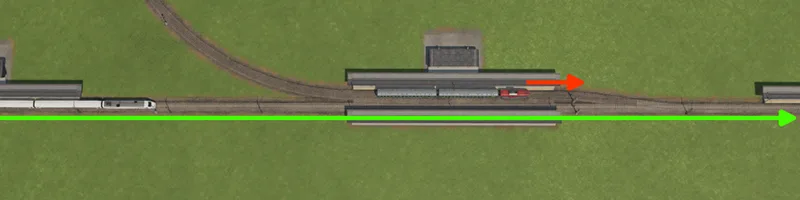
Compare the highlighted routes where services use shared track.
A practical priority setup therefore has two parts:
- A meaningful difference between the competing lines’ priority settings.
- Track and signal placement that leaves a clear path for the protected service and a non-blocking waiting position for the other train.
The control is most valuable at recurring conflicts. A single unusual delay caused by loading, a blocked station, or a train already occupying the route may not indicate a priority problem. Look for a repeatable pattern in which the same lower-value service repeatedly claims shared track before the line you want to protect.
Choose which service should go first
Train priority works best when it expresses a clear operational decision. Do not start by asking which train looks faster. Decide which journey is more costly to delay, then assign the relative priority accordingly.
| Network situation | Priority decision | Infrastructure condition | Result to observe |
|---|---|---|---|
| Express and regional lines share a junction | Give the express line higher priority | The regional train has a safe place to wait clear of the junction | The express reserves the shared path and passes first |
| Through service passes a station used by stopping trains | Protect the through line if its journey matters more | A usable through or passing route exists | The through train continues while the stopping service remains clear of its path |
| Two equally important services alternate through one constrained section | Priority may not provide a meaningful preference | The shared section still has limited capacity | Observe whether the real issue is insufficient track capacity rather than line precedence |
| Every railway line has the same high setting | Restore a deliberate difference between competing services | Their routes must still remain usable | The chosen service receives the intended reservation advantage |
| A train waits because another vehicle physically occupies its only route | Priority alone cannot clear the track | Add or free a usable path before expecting a different result | The protected train has an available route to reserve |
A good candidate for higher priority is a line whose delay propagates through several later stops or whose schedule depends on maintaining a clear long-distance run. A lower-priority candidate is a service that can wait on a side track without blocking other movements. These are planning criteria, not automatic game rules: the correct choice depends on which journey you want the network to protect.
Avoid assigning higher priority merely because a line is new or expensive. The setting should represent the relationship at the shared conflict. If the favored line never overlaps another railway path, changing its reservation priority will not solve an unrelated delay elsewhere.
Give the lower-priority train somewhere safe to wait
A priority difference cannot compensate for a junction where the waiting train occupies the crossing. When paths overlap, leave enough clearance after switches or crossings. A train stopped at a signal too close to the junction can block another line even though the other service has higher priority.
The waiting area must fit the full length of the longest train that will use it. If the tail of that train remains across the switch or crossing, the protected route is still obstructed. Move the stopping point far enough from the conflict that the entire train can wait without fouling the other path.
Signals also define the sections that trains reserve. A railway path ends at the next signal, tram lane, or reversal stop on the train’s route, whichever comes first. You do not need to redesign the entire railway before using line priority, but you do need to inspect the immediate conflict and confirm that the available sections support the movement you expect.
Rail stations can support intermediate tracks without platforms for passing trains, but such a route must actually exist and connect correctly. Priority cannot send an express around a platform-bound train if there is no usable bypass. Likewise, adding a passing track does not help when the line’s route never uses it or the track is blocked at an entrance or exit.
Verify the change with a complete encounter
The most reliable test is an ordinary repeat encounter between the same two services. Begin watching before either train reserves the contested section. If you arrive only after one train has entered the path, you may be observing the consequence of an earlier reservation rather than the new priority decision.
Use the following verification sequence:
- Open both competing lines and confirm that the intended service has the higher setting.
- Return to the shared junction or passing section before the trains arrive.
- Observe where the lower-priority train stops and whether it remains fully clear of the protected route.
- Follow the higher-priority train until it has passed through the contested section.
- Continue watching until the waiting train starts moving again.
- Repeat the observation if the first encounter began with a track already occupied or another train affecting the junction.
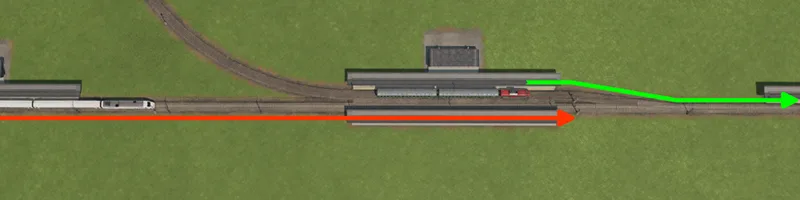
The highlighted paths show how the station route joins the shared railway.
Do not treat a fixed number of upcoming signals as a universal reservation range. Judge the actual movement: the important evidence is that the preferred service reserves the shared route early enough, passes through it, and leaves the other service able to continue afterward.
Also trace the complete line after any routing change made during troubleshooting. A local adjustment is not successful if it breaks the stop order or disconnects a later part of the service. Priority itself does not redefine the route, but players often change waypoints, station tracks, or junction geometry at the same time and should verify the whole line afterward.
Diagnose priority that appears not to work
The competing lines still have equal priority
Inspect both lines. Raising the preferred line does not establish a useful distinction if the competing line is already set equally high. Decide which journey should receive precedence and keep a relative difference between them.
The lower-priority train blocks the junction while waiting
Look at the stopped train’s full length. If any part of it remains over a switch or crossing, the protected train has no clear route. Place the waiting point farther from the conflict and leave enough clearance for the longest train using that approach.
There is no usable passing route
A higher-priority train cannot pass through another train. If both services converge onto one occupied track, the setting cannot create an alternative. Provide a connected passing or side route if the preferred service needs to move around a stopping train, then verify that the intended line actually follows that route.
The delay happens at a station rather than the shared approach
Check whether the destination track is occupied by a loading or unloading train. Reservation priority addresses competition for track; it does not empty an occupied platform or turn a platform track into a through track. If a service needs to bypass the station, it requires a usable route that does not depend on the occupied platform.
A waypoint and priority are being treated as the same control
They solve different problems. A waypoint obligates a line to travel through a chosen location and can influence which route it follows. Priority decides how competing services reserve shared railway track. Use a waypoint only when the line is taking the wrong route. Use priority when the route is correct but the wrong service repeatedly receives the shared path first.
Preferred or alternative platform selection is also separate from reservation priority. Platform choices determine which station track a service uses. They do not replace the line-priority setting that governs competition at shared railway sections.
The test begins after the route is already occupied
Observe an encounter from before both trains reach the conflict. If one train is already inside the shared section, watching only the final approach does not show which line originally secured the path. Repeat the test under a clean, ordinary encounter before changing the layout again.